Navigation

May 8, 2012

LumoLabs: Nikon D800/E outer AF sensor accuracy

We found the Nikon D800 and D800E to be wonderful cameras. But there are some reports floating around the web that the performance of the outer AF detectors is subpar. Especially with a fast and/or wide angle lens like 24mm f/1.4 or 14mm f/2.8 where it may be considered broken. Especially with the leftmost AF point. We decided to evaluate the issue with the scrutiny of a laboratory test. And to compare two samples to figure out if the issue is consistent across units or isn't.

And this is what we found ...

Results

Required AF finetune adjustment value for accurate focus depending on the focus point for one sample D800/E.
Required AF finetune adjustment value for accurate focus depending on the focus point for another sample.
In the charts above, the "floor" represents the layout of the 51 AF sensors of Nikon's Advanced MultiCam 3500FX module. We evaluated the performance of 5 out of these 51 focus points, positioned according to the yellow bars. The larger the bar, the larger the focus error without an AF finetune adjustment. The bar denotes the required AF finetune adjustment to compensate for the focus error. Measurement done at 24mm, f/2.8, tungsten light and with 1.2m subject distance.

We conclude that the issue with the accuracy of the outer AF focus points of the D800 is real and probably affects all units out there to some (varying) extent. It is said to be pronounced at ultra wide angles. However, we found it to be (just) unacceptable at 24 mm as well. We guess that every camera with the "Nikon Advanced Multi-CAM 3500 FX" auto focus module is affected, i.e., D800, D800E and D4.

We evaluated the characteristics of the sample variation of the issue and found that the cause may not be consistent across units. There may be a mixture of a tilt problem (such as caused by a misaligned AF auxiliary mirror, possibly independent of the focal length) and a parallax problem (such as caused by a decentered AF relay lens, possibly dependent on the focal length) where both components contribute with variable strength from sample to sample (our statements about possble causes are speculative, our statements about tilt and parallax errors and sample variation are not).
Therefore, we express our concern if the issue can be cured by a simple firmware patch. As far as we can see, such a patch would require at least two additional calibration parameters. We rather see many units undergo a thorough re-calibration job at Nikon.

Breaking news: According to www.nikonians.org/forums/dcboard.php?az=show_topic&forum=430&topic_id=7054&mesg_id=7054&page=#7303 , a Nikon service center has been able to calibrate the outer AF points of one unit, much in line with our findings which suggest that each camera has to be cared for on an individual basis. It remains to be seen what procedure Nikon will propose to customers in general though.

Meanwhile, we recommend to be cautious when using all but the center 15 cross type AF points for any work relying on critical focus, at least on the wider end of focal lengths.

Further reading:

We provide full documentation of the lab testing which my friend Dieter Lukas from panobilder.de and myself did in order to classify the D800 outer AF sensor issue. Please refer to:
We strongly suggest you follow the above material before asking questions which are answered already ;)


Update (2012, June 20):

As detailed in our full document (cf. above), we used FoCal software from Reikan to determine the AF adjustment values required for each focus point (we had to use a trick to work around the FoCal limitation to only test for center AF point accuracy). We actually recommend their software for normal AF lens calibration.

Interestingly, Reikan is now producing a version of FoCal which is able to test for the consistency of all AF point. We highly recommend all D800 users to aquire and use this software (when out) in order to check for their own camera. Read more about it here:
Moreover, please feel invited to share your (then accurate) findings in the comments section. Thanks.

Meanwhile, we have officially asked Nikon Germany for a press statement about the issue but have received none to date. We'll keep you posted.

Update (2012, June 24):

There is an interesting blog article from hifivoice:
reporting about the status of repair attempts by Nikon Service Centers, and how Nikon Netherlands has taken a lead in the absence of clear directions from Japan yet. It becomes clear that the issue affects many, although probably not most, cameras. And that currently, a fix exists which cures most, although not all of the symptoms of the issue.


Enjoy the read and thanks for stopping by,

Dieter & Falk

April 7, 2012

LumoLabs: Nikon D800 video function demystified

Nikon D800 FX mode 1080p video frame (click for original size)
The Nikon D800 full frame SLR camera has created a lot of buzz recently. Some would call it hype. While it is clear that its 36 MP still resolution is pretty much unparalled in the 35mm camera class, the final verdict about its video subsystem is still out. Esp. in comparison with Canon's 5DmkIII.

One point of interest has been how either camera actually creates its video frames. I now had a chance to apply LumoLabs' testing methology to a loaner D800 camera and figure it out for 1080p video in FX mode. I am having a look at live view performance too.

You may jump to the conclusion at the end if you just want to read what we found, igoring how we did it :)


Nikon D800 FX mode FullHD 1080p video

The title image shows one frame from a 1080p video taken with the Nikon D800 (in FX mode, it supports a number of crop video modes too). It shows a zone plate test chart which can be used to perform a sampling error frequency analysis.

Please, read falklumo.blogspot.de/2009/10/lumolab-welcome-and-testing-methodology.html to learn more about the testing methodology incl. access to the original of the test chart allowing everybody to replicate my analysis.

There is a bit of (gray colored) moiré from the printing process. This is because scaling and printing of zone plates is a non-trivial art in itself ;) You can actually measure the printer's native resolution by inspecting the printed zone plate chart. Below, you find a photograph of the print (in 14.6 MP resolution) allowing you to determine what moiré patterns are from the printing process actually.

Printed zone plate chart (still shot with a 14.6 MP camera, for reference)

However, all colorful moiré patterns are artefacts introduced by the D800 video system. It allows us to precisely measure how it works. Let's have a close look at the one of the two center discs:

Analyzed region of interest in the D800 video frame

The big discs are constructed such that the 1080p Nyquist frequency emerges at its outer circle. The two center discs have their edge at twice this Nyquist frequency and the four tiny discs at four times this frequency. Therefore, the false color moiré disc emerges at (149px/258px x2) or 1.155x the 1080p Nyquist frequency (1247 px). This means that the Nikon D800 samples ~1247 horizontal lines from its sensor.

Now, let's make a back-of-the envelope calculation:

An FX frame in video mode is taken from a 6720 x 3780 px region (which actually is a 1.095x crop from the full 7360 x 4912 px frame (this information is from the Nikon user guide, translating physical dimensions into pixels). Because 3780 / 1247 = 3.03 and because 1% is our measurement error, we have proof that the Nikon D800 samples every third horizontal line from its sensor.

A second result is that the ever so slightly color moiré for horizontal frequencies disappears at the Nyquist frequency. The D800's AA filter is effective here, the remaining moiré is from the printing. The D800E would have a bit of additional color moiré here, but by far not as strong as in the vertical direction. So, I believe that the Nikon D800 samples every vertical row from its sensor.

Below is what I believe how Nikon implemented line skipping:

Likely D800 sensel sampling matrix

and here is a slightly more symmetrical scheme which I cannot entirely exclude although I think it isn't used in this mode:
Unlikely sensel sampling matrix
If you look at the likely sensel sampling matrix, you'll see that all sensels which are read out (the ones with a color) result in a new RGGB Bayer matrix of sensels. Which has the advantage that a standard demosaicing algorithm is applicable to create an RGB frame.

This is similiar to what the Canon 5DmkII did actually. However, there is one important aspect where the D800 is different:

A native 1080p video frame is 6720 x 1260 px, demosaiced to a 2240 x 1260 px RGB frame.

And the final 1080p video frame is further downsampled 7:6 to 1960 x 1080 px which gives the D800 a slight edge in resolution and edge flicker behaviour over a 5DmkII.


High ISO noise in video

What we found has one important consequence: High ISO noise in video! Because of the FX video crop and skipping two thirds of sensels, the ISO performance in video is shifted by a factor 3.60. E.g., At ISO 12,800, the noise looks (as bad) as at ISO 46,000 from a camera using all available sensors for video (except for the 16:9 ratio crop of course).

You may note however, that the D800 still samples 6720 x 1260 sensels for a 1920 x 1080 frame or 4.08 sensels per pixel. For this reason, at ISO 12,800, the noise looks (as good) as at ISO 3,200 from a still image when pixel peeping at a 100% (1:1) level. So, pixel noise in D800 video is 2 stops less compared to still while it could have been 3.85 stops less when reading out a maximum of sensels. If you consider this bad or good is up to you.

Below, I have extracted frames from the ISO comparison performed by crisislab.com:

Video noise comparison D800 vs. 5DmkIII -- original frames (c) 2012 crisislab.com
On the left hand stripe, I have shifted the D800 samples two stips down and I think, it is a good match for the 5DmkIII performance then.

From that, I can already conclude that the 5DmkIII reads out all its sensels, i.e., does no line skipping. However, I didn't run a resolution analysis for the 5DmkIII. However, hearing about resolution complaints for 5DmkIII video, I think they bin pixels before read out. This improves noise and aliasing performance but unlike downsampling, doesn't help the resolution.


Nikon D800 Live View implementation notes

I have applied our testing methodology to Nikon's live view implementation too.

D800 live view, photograph of the rear LCD (no zoom level)
You see the same false color moiré discs which we have analyzed already. Of course, there is some strong additional moiré from the LCD rasterization. I.e., the D800 only reads every third line when activating live view (in the example, it is FX video live view).

If we zoom in, we get a result as follows.

D800 live view, photograph of the rear LCD (high zoom level)
You now different false color moiré disc, they have moved outwards. The sampling frequency is  (1692px/1935px x2) or 1.749x the 1080p Nyquist frequency (1889 px). Because 3780 / 1889 = 2.00, we have proof that the Nikon D800 samples every second horizontal line from its sensor when zooming enough in live view.

In live view, the D800 switches from third line to second line skipping when zooming in!

Lessons for manual focusing: (1) zoom in and (2) focus onto vertical structures which have twice the resolution in live view! Focus on trees, edges of buildings rather than horizon or roof top.


Conclusion

The D800 creates FX 1080p video in the following way:
  1. Crop a region of 6720 x 3780 sensels (crop factor 1.095).
  2. Read only every third line out of this region, but all sensels in a line. The result is an 6720 x 1260 sensel RGGB Bayer pattern which can be demosaiced.
  3. The resulting 2240 x 1260 RGB image is downsampled 7:6 to the final 1920 x 1080 px resolution.
  4. Compared to an optimum architecture, only 1/3.6 of sensels are read which makes the D800 loose up to 1.8 stops in high ISO video performance.
  5. When zooming into a live view image, the D800 switches line skipping from 3x to 2x.
  6. Manual forcus should use zoomed live view focusing vertical edges.
Overall, I am personally pleased with the implementation Nikon has chosen. It refines an idea originally used in the 5DmkII which is more difficult to implement due to the higher overall number of pixels. Because of downsampling from 1260p to 1080p, I actually expect slightly better resolution than from a 5DmkII or a camera which bins sensels prior to demosaicing.

On the other hand, there will be no more excuses for line skipping in the future. Not after Nokia got rid of it in their 41 MP 808 mobile phone ...


Enjoy your read :)
Falk

March 16, 2012

Apple iPad 3: A first screen evaluation

Screen comparison of The new iPad (iPad 3, left) and the original iPad (iPad 1, right)
The image is shot in tungsten ambient light.
White balance is set such that a white background on the iPad 1 appears white.
Both devices show a page in iBooks using the Sepia theme.
Image (c) 2012 Falk Lumo
Above is a direct comparison of the Retina screen of the New iPad (left) to the original iPad (right).

Please click onto the image to see the full size image exhibiting the physical pixel structure of each device.

As you can see, the new iPad has a much higher resolution (Apple says 2048 x 1536). Apple also claims the new iPad to have "44 percent greater color saturation". Photos definitely are displayed with incredible detail. There certainly are photos which looked ok on older devices or even a computer screen but are ugly on the new iPad. Especially artefacts from too strong a noise reduction are very visible on the new iPad. Therefore, the new iPad sets a new proof reading reference for photographers.

However, I must say that I am a bit concerned that on the new iPad, the "Sepia" iBook theme certainly doesn't appear Sepia at all. It has a definite greenish color cast. You may look at the image above to see what I mean. To be fair, in that image the white balance was calibrated to a white iPad 1 background. However, the image shows exactly what my subjective impression was too. And objectively, the iPad 3 is more Greenish and less Reddish than the iPad 1. The iPad 3 is a production device delivered today.

One may think that the difference is in color temperature only. However, if I calibrate for white balance of the new iPad or the iPad 1, they both calibrate to the same color temperature. It is the so-called "tint" which is different. Therefore, one or both of the iPads have a color cast.

So, I am wondering what is going on here?

Does the iPad 3 lack a color profile that it certainly would need?

And if this is the case, does it make the new iPad obsolete as a serious tool for photographers?

I hope that Apple will soon issue a statement of clarification.


UPDATE 10 days later:

In the Apple support forums, a minority of users expressed the opinion that the cause for the yellow/green tint is glue which just has to dry. So, letting the screen burn in would resolve the issue.

After a bit over 10 days with most of the time powered on at full display brightness, I am sorry to report that the effect of burn in is zero. It is NOT a glue problem (for the new iPad). See for yourself:

Screen comparison of The new iPad (iPad 3, left) and the original iPad (iPad 1, right)
-- After ten days of continuous burn in of the iPad3's display --
The image is shot in tungsten ambient light.
White balance is set such that a white background on the iPad 1 appears white.
Both devices show a page in iBooks using the Sepia theme.
Image (c) 2012 Falk Lumo

Moreover, I carried my sample of the iPad3 to my local Apple Store. I showed it to a store manager. Without hesitance, he confirmed that there is a problem. I then looked at three other iPad3 devices the store had on display. They all had the yellow/green tint if compared to an iPad2. Although to a lesser extent than mine and one device, I would have deemed acceptable. Therefore, there are better iPad3 devices out there. Nevertheless, the device shown in my blog article is still quite typical of what to expect in any individual case.

The store manager advised to mark my sample as defect if it is engraved and returned. I asked how Apple could ever repair it if all devices have the same problem to some extent. He meant he has no clue but I should contact a genius :)

End of UPDATE


Thanks for having stopped by,
Falk

March 5, 2012

The iCamera (Nokia 808 Pureview) Part I


Why "The iCamera"?

Because in my opinion, this term would best describe what this camera is all about. Camera? Yes, I consider the Nokia 808 Pureview to be a camera (which happens to have an embedded phone), not the other way round. Nokia may not like this perspective. Not yet. Further down, I am going to explain why it is such a great revolutionary camera. But first, let me explain why I call it the iCamera. And no, I will not say anything about the iCamera's embedded phone function. Please, refer to Nokia for further details about the phone.

Remember the iPhone back in 2007? The year the 808 project was started? "It is an iPod, a phone, and an internet communications device". Some laughed at it, but it became the blueprint for almost every smartphone made since. And a big success. And what matters most: it came from a company who never did a phone before! Launched after years of hidden development.

Now, you have "a camera, a phone, and an internet communications device". Some laugh at it, but it may become the blueprint for almost every compact camera going to be made. It comes from a company who never did a camera before! Launched after years of hidden development.

Nokia may not realize what they did and actually may still screw it up. But if they play their cards right, they can create an entirely new market and rule it! A photography market. Just let's forget for a second that the 808 is also a phone. The iPhone is also an iPod. So what?

And so I call it the iCamera.


Why is it revolutionary?

A product becomes revolutionary if it combines existing technologies in a way that the result leapfrogs several generations of competing products and seems to contradict common wisdom. The 808 does this. Let me explain in detail now.

First, let me classify the iCamera. You need to read my paper about camera equivalence though. You'll find it here:
It explains how to correctly compare cameras when they have different sensor sizes. The 808 is two different cameras at the wideangle and the long tele end. And another different camera in video mode. I give three 35mm equivalent cameras at both ends now (ISO are the minimum equivalent values), followed by 5 other cameras serving as a reference:
  • Wide iCamera:      28mm/8 iso640 (38MP, 169g)
    exact: 38.4 MP (4:3), 27.7 mm, F8.3, ISO 690 (crop 3.45)
  • Long iCamera:      77mm/22 iso6400 (5MP, 169g)
    exact: 5.0 MP (4:3), 76.6 mm, F22.9, ISO 5300 (crop 9.55)
  • Wide video iCamera:      26mm/8 iso640 (HD, 169g)
    exact: 2.1 MP (16:9), 25.7mm, F7.7, ISO 590 (crop 3.2 wrt 4:3)
  • Apple iPhone 4:      29mm/22 iso4800 (5MP, 137g)
  • Wide Olympus E-P3 + 14-42/3.5-5.6II:      28mm/7 iso400 (12MP, 481g)
  • Long Olympus E-P3 + 14-42/3.5-5.6II:      84mm/11 iso400 (12MP, 481g)
  • Wide Nikon D800 + 24-70/2.8G:      24mm/2.8 iso50 (36MP, 1800g)
  • Long Nikon D800 + 24-70/2.8G:      70mm/2.8 iso50 (36MP, 1800g)
Please, refer to the Nokia White Paper for the 808 specification and further details.

Even though the tele effect (Long iCamera) is achieved via simple cropping, it is equivalent to a different camera. Very much like a zoom lens which yields different focal lengths and apertures at both ends. Equivalent means you should expect the same indistinguishable image quality from a full frame 35mm camera with the given specification. Please feel invited to read the paper above to understand the details (applies to Nokia employees too: please understand why your way to zoom via crop is not equivalent to a constant aperture zoom).

In a nutshell: the above list allows for a direct, quick and no-nonsense comparison of available products.

And it shows that the iCamera is physically very close to a mobile smart phone (actually, Nokia says it is one) but its optical performance is rather close to a mirrorless system camera, only significantly bettered by a big full frame SLR with a fast lens.

So, in optical performance, the iCamera leapfrogs all mobile phone and P&S cameras, while in resolution, it additionally leapfrogs all mirrorless system cameras and even APS-C SLRs.

Of course, in order to make this claim, we have to check if the 808's lens is up to the task. So, let's refer to some sample images which have been published already

Image taken with the Nokia 808 Pureview (the iCamera). © 2012 Nokia (click to access original)

The above image is taken with the Nokia 808 Pureview (the iCamera). The image is mildly post-processed by me in a way typical for other photo cameras in JPG mode (the image is a bit sharpened and noise-reduced) to provide an easier reference for a direct comparison (the 808 seems to apply no or almost no post-processing to its results which is a good thing for photo enthusiasts).

The above image is an example of good image quality for a mobile phone or almost acceptable image quality one would expect from a system camera with a kit zoom. Most details are resolved but there remain a few sharpening/denoising artefacts.

So far, this is nothing spectacular or worth talking about.

But what if I tell you that the above is an 18x crop (1:1 or 100% crop) taken from the following image?

Image taken with the Nokia 808 Pureview (the iCamera). © 2012 Nokia (click to access original)

The above is the full and same image as shown above! Only resized to the typical web size. And now and immediately, you may understand why the iCamera is like no other camera before!


The Zeiss lens

Moreover, this example clearly shows that the lens is up to the task and able to resolve the incredible resolution of the sensor. Closer inspection of the original images reveals even the corner resolution is  good even if it doesn't fully resolve the sensor, still beating most other available cameras in the corner. A more complete analysis was done by Werner Ruotsalainen: Nokia 808 resolution tests. He concludes that even the smaller 5 MP images from the 808 beat 10 MP images from a P&S in resolution! And there are reasons to believe this to be true.

But how can a mobile phone lens resolve such tiny detail? Good question. As I explain in my paper about camera equivalence, it becomes increasingly harder to resolve many pixels when shrinking the sensor size.

But famous lens maker Zeiss did an incredible job solving this problem: By glueing 5 lenses together into one group, all having aspherical surfaces and one using ED glass, they created a lens with unprecedented optical performance and very tight manufacturing tolerances. The problem is larger than it appears: The lens aperture is only 3.34mm while the image circle 8mm further down the optical axis is a whopping 12.5mm, almost 4x the aperture. If the aperture were as large as the image circle, this would be an f/0.6 lens! So, the lens elements nearer to the sensor are larger than they appear when looking at the camera front. Such a lens must be mounted to the sensor assembly on extremely tight tolerances or it is decentered. We have to keep in mind that the iCamera's lens is diffraction-limited at F2.4! Nokia uses a live manufacturing method where live view from the camera is used to fine calibrate the lens when assembling the sealed camera module. That's fairly innovative by itself and definitely virgin territory. This method won't work for an interchangeable lens camera. More on this below.

UPDATE 2012, March 5:
Today more information about the lens was made available by Nokia and Zeiss.
Zeiss 808 8mm/2.4 lens
source: http://conversations.nokia.com/2012/03/05/nokia-808-pureview-carl-zeiss-science-of-making-the-perfect-lens/
The lens is depicted in the image above and as it said in the source, it is made from a special plastics rather than glass. This is only possible for small lenses like the one in the 808 but has the advantage that much more complex surfaces can be made to precision. That seems to be part of the recipe how to achieve the high optical performance despite the small footprint. END OF UPDATE.

So, we conclude that the optical performance figures are hard to believe but they seem to be real.

But this isn't everything yet. We saw that the wide iCamera is equivalent to a camera with rather low ISO setting. So, it should have good dynamic range. And indeed, this seems to be true. I treated the above image in an HDR manner and came up with the following result:

Image taken with the Nokia 808 Pureview (the iCamera). © 2012 Nokia (click to access original)

The above is is still the same image as shown above! But now we used the iCamera's dynamic range to heavily boost shadows to illuminate the black regions of the original image. That's not normally possible with images from mobile phones.

The reason why this works is that the iCamera has a large sensor, much larger than mobile phones or P&S cameras. It is almost as large as the sensor in the mirrorless Nikon 1 system cameras. The equivalent camera parameters express this as an equivalent ISO value of 640 which is known to be good enough to have enough headroom for extending an image's dynamic range (like I did above).

I hope that all the text above answered the question why the iCamera is indeed revolutionary.


One more thing ...

It wouldn't be The iCamera if there wouldn't be one more thing ... :)

All still photo cameras have the problem that the sensor has many more pixels than there are in HD video. But it is hard to read out all pixels of a still image (10 MP or more) 24, 25, 30 or even 60 times a second. Therefore, still cameras only read a small fraction of its pixels to make the video stream, known as subsampling or line skipping. The effect is a significant degradation of image quality in video mode: there is noise, line flicker, color moiré and the result is no match for HD content produced with so called 4k cameras or cameras with supersampling such as the Canon C300. Such cameras cost $15,000 or more (a notworthy exception is the Panasonic GH2 though which made it the camera of choice for serious video work on a budget).

And what shall I say? The iCamera does it too, not supersampling 8MP (C300) or 16MP (GH2) but supersampling all 33,593,616 pixels (16:9) 30 times every second! That's one billion pixels the iCamera processes every second. In a mobile phone. This is crazy!

As a consequence, the wide iCamera could have the same good low light capabilities in video mode as the legendary Canon 5DmkII which does line skipping, but without the Moiré and line flicker problems.

And because no graphics processor (GPU) obviously can handle this data rate (otherwise, HDSLRs would be able to do it too), Nokia designed a special chip (the scaling processor) which sits in the camera module between the sensor and the GPU. And Toshiba managed to make a sensor which can output the equivalent of 8 GBit/s. So, there is a large CMOS sensor, a scaling processor, a graphics processor and the ARM CPU chewing each others output to get the job done.


The people behind

Nokia was kind enough to emphasize the role of three persons in this project:

Eero Salmelin and Juha Alakarhu (Nokia "pureview inventors")
Source: http://conversations.nokia.com/2012/02/29/zooming-in-on-nokia-pureview/
Damian Dinning (Nokia "imaging guru")
Source: http://conversations.nokia.com/2012/03/01/nokia-pureview-qa-with-damian-dinning

I believe that the creation of the iCamera was driven by opportunity rather than strategic planning. Nokia decided to give engineering green light to pursue the project and see where it leads to. And I guess they are still watching. The Nokia press conference only "mentioned" the 808. And that's the real difference between the iCamera and the iPhone: the iCamera isn't top-level driven, it is not born out of vision from the leaders. It is born out of engineering vision and often, this is not enough.

So, here is my humble advice to Nokia managers who are only watching the 808:


Implications

The iCamera is such a groundbreaking device that Nokia must no longer consider themselves a phone maker.

The iCamera is such a groundbreaking device that Nokia must no longer consider themselves a phone maker.

( I said it twice on purpose.) Like the iPhone made Apple drop the "Computer" in "Apple Computer", Nokia may consider to drop the "Phone" in their brain. They may continue building great phones just like Apple continues to build great computers. But now, they have to become a camera maker and whatever this leads to. Nokia engineers may have understood it already: They provide a tripod mount and a decent camera user interface.

It is useful to consider what the iCamera could be in another form factor (less phone like) and to remember that interchangeable lenses wouldn't necessarily deliver (cf. above). The "lens module" concept then comes to mind. Where a lens module is exactly what the camera module is in the 808: A sealed module containing lens and sensor. And therefore, a system camera would become:

A mirrorless interchangeable module camera (MIMC).

Nokia wouldn't be first (Pentax Ricoh Imaging with their GXR line is first). But an 808-based MIMC would be the first camera where this concept actually makes sense: Because it delivers a level of performance not possible otherwise. And at an attractive price point considering the Nokia 808 minus the phone isn't more expensive than a system camera's lens.

Nokia could create the future and dominant kind of camera market between the phone and 35mm full frame system cameras. And they could reestablish a European camera industry just like Apple revitalized a dying US phone industry. There are good cooperation partners to the task, like Zeiss or Leica. Nokia may even consider to make a GXR module to test the waters.

Anyway, personally I plan to release more parts to this article after I got the chance to run some laboratory tests. It will be exciting to see what all of this leads to.

Enjoy your iCamera.

February 21, 2012

LumoLabs: Camera equivalence

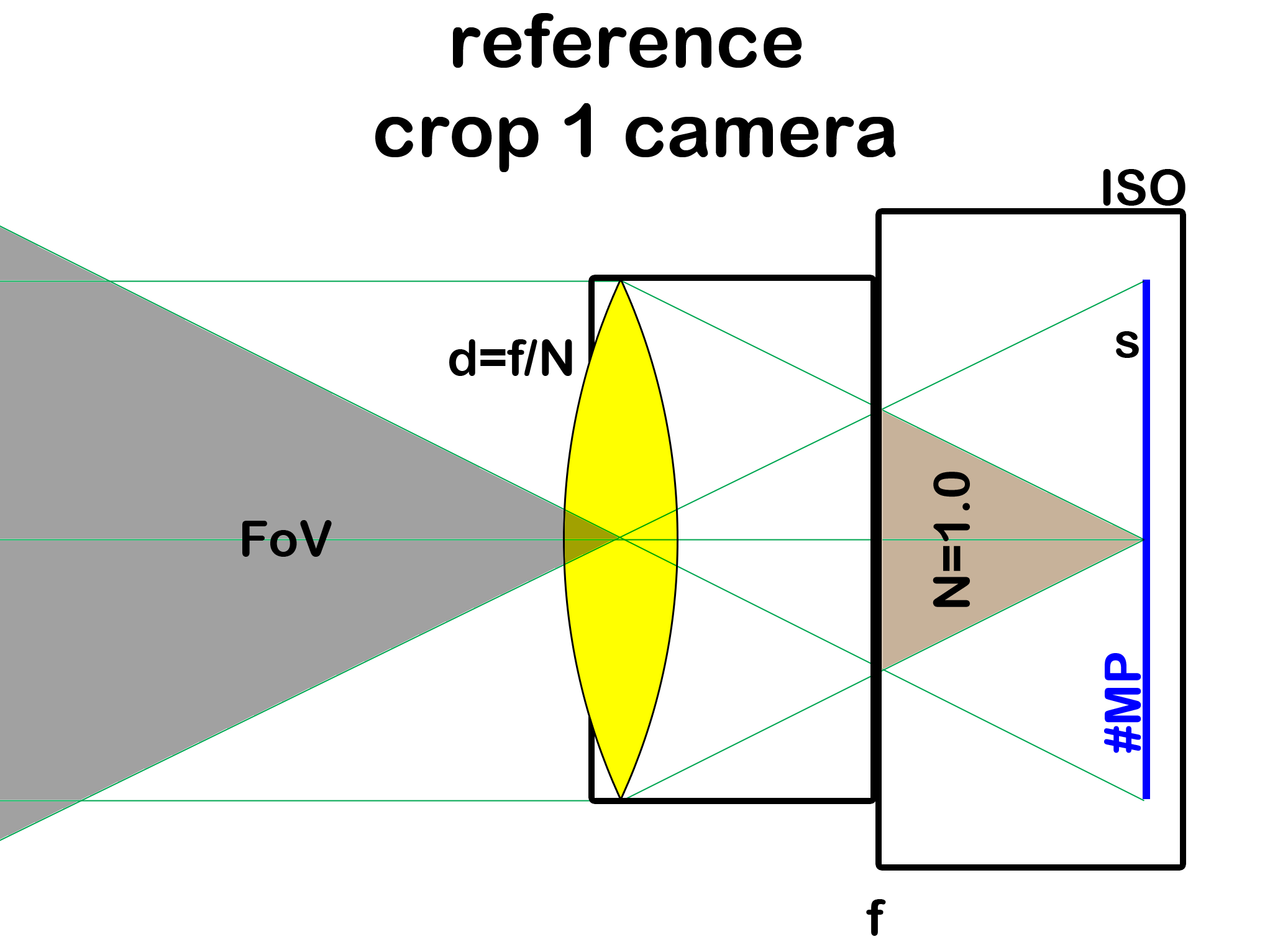
Various parameters, or variables of a real camera or a reference camera are depicted above

In preparation of an article discussing the advantages and disadvantages of various sensor sizes for a given camera performance, I try to set a common ground for such discussions.

I have prepared a white paper which dives much deeper into the topic than is possible in this short blog article. You may find it here:
The short version is this: An image contains no information whatsoever about the size of the sensor within the camera which was used to capture it. None. Nothing. Nada. (except EXIF of course ;) ) The proof is beyond the scope of this blog article and the article only gives some clues. But this is a fact, trust me.

Therefore, all cameras which could have captured a given image create a so-called equivalence class: they are all equivalent, producing indistinguishable images. And they have different sized sensors! By camera, I mean a camera with all the parameters defined it used to capture an image, such as the variables shown in the title image. Changing any variable "creates" a different camera. The exposure time used to capture an image is defined implicitely too: the one giving correct exposure (and it is a constant of course for indistinguishable images).

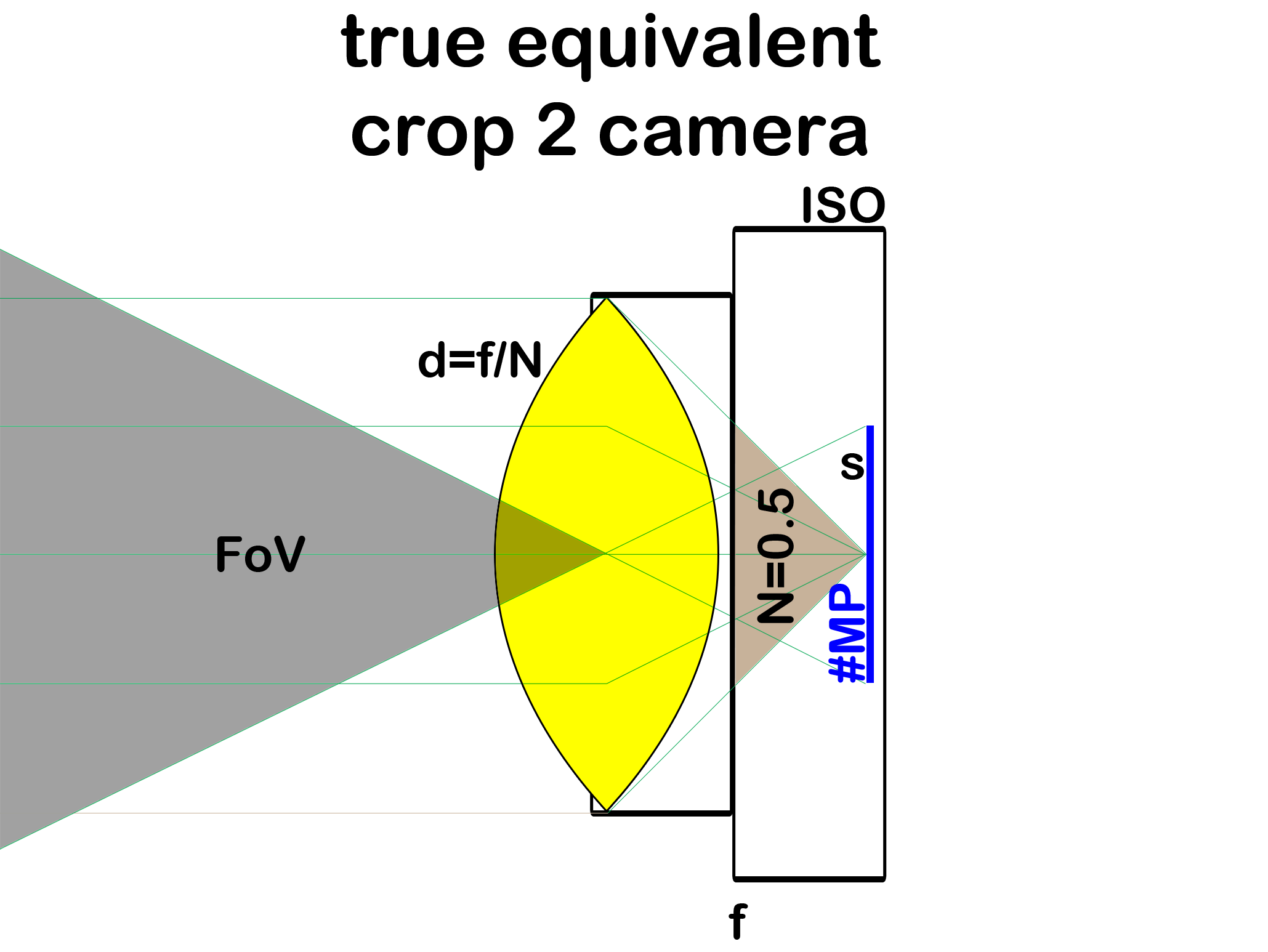
The following image shows an equivalent camera where the sensor has only half the size of the first or reference camera, i.e., an equivalent crop-2 camera:
The camera's lens has the same absolute diameter but it's focal length is shorter to maintain a common field of view. The equivalent crop-2 camera has a different F-stop and ISO sensitivity.


Main claim:

Any discussion about the impact of varying sensor sizes must be based on cameras made equivalent first. Otherwise, any comparison will just reveal the inequivalence of parameters the respective cameras have been set to and nothing else. And such a result would be trivial, known and not worth a further discussion.

Such trivial results are that a larger sensor produces a more shallow depth of field or less image noise. This is not true! Because it just means that the cameras were used with non-equivalent settings, e.g., with lenses of different diameter d which means with lenses of different weight and cost. Another example are ISO comparisons between cameras with different sized sensors but ISO kept the same. Such comparisons are pointless! Instead, compare a FourThirds camera at ISO 100 with a full frame camera at ISO 400 because only then they are equivalent. Not doing so just compares the size of lenses which a ruler can do just as well.


Secondary claim:

Once equivalent cameras are compared, results start to become interesting. Because now any deviation is due to deviations with respect to an ideal camera. Such like a lens with aberrations, production or design tolerances or compromises in a CMOS production process. The white paper explains that such deviations are generally expected to be larger with smaller sized sensors. Of course, one such deviation is obvious: when an equivalent camera doesn't exist for a sensor size, e.g., because an f/0.1 aperture is unfeasible.


I will follow up this article with a more complete article of the impact of sensor size on image quality.

Stay tuned and enjoy your read :)