Navigation

Showing posts with label Nikon. Show all posts

September 21, 2012

Photokina 2012: Nikon talks about the D800's outer AF issue

"I AM here4U" at Photokina 2012

Note: A copy of this blog article has been published in German language too. Please refer to the corresponding version (Deutsch) before posting comments. Thank You.

Prior to Photokina, I had scheduled a meeting with Nikon Germany, partly in order to discuss the known issue regarding the outer AF focus fields of the Nikon D800 camera.

So, on Tuesday I had the pleasure to discuss the topic extensively with both Michael Wollburg (Manager Customer Support Nikon GmbH) and a Nikon technician in charge. The meeting was very friendly and constructive.

Photokina 2012: Nikon spricht über das D800 AF Problem

"I AM here4U" at Photokina 2012

Note: A copy of this blog article will be published in English language too. Please refer to the corresponding version before posting comments. Thank You.

Ich hatte im Vorfeld der Photokina mit Nikon Deutschland vereinbart, ein Gespräch u.a. zum bekannten Problem der äusseren AF Sensoren bei der Nikon D800 Kamera zu suchen.

Am Dienstag hatte ich nun Gelegenheit, die Angelegenheit ausführlich mit Michael Wollburg (Manager Customer Support Nikon GmbH) sowie einem anwesenden Techniker zu besprechen. Das Gespräch war sehr konstruktiv.

September 17, 2012

Photokina 2012: First Impressions

Photokina girl showing the new Fuji X-E1 mirrorless with EVF
I have just returned from my first trip thru some of this year's Photokina booths.

First things first: I've met Adam and Oleg from pentaxforums.com and it was great and very enjoyable to assign faces to big names :) They even gave me an official pentaxforums.com shirt which I really enjoyed.

Of course, this is before official opening and most booths and some halls are still blocked, esp. to the to the press. But I had a chance to have a glimpse at most of the recently announced stuff. It is all here :)

September 13, 2012

LumoLabs: Using FoCal for testing of an AF sensor array

A2C2 (AFMA Array Color Chart) produced by FoCal for a Nikon D800E with Nikkor 24-70/2.8G lens at 24mm f/2.8 at 1.2m distance.
Previously in my blog, I reported about an issue with the D800 AF sensor array to provide accurate enough results when using its left bank of sensors (cf. /2012/05/d800-outer-sensors.html). The issue seems to be rather general, affecting many Nikon cameras with that AF module produced until now, i.e., D800, D800E and D4. E.g., until Nikon ceases to remain silent on the topic, Thom Hogan decided to flag the D800 "Not Currently Recommended" (www.bythom.com/nikond800review.htm).

July 24, 2012

The iCamera (Nokia 808 Pureview) Part II: In the studio ;)

A still image taken in the studio by the Nokia 808 Pureview mobile phone
-- Please, click onto the image to access the uncropped full 38.4 megapixel image --


First of all, I'd like to clarify that this article isn't meant seriously. The Nokia 808 Pureview (808PV) isn't a studio camera. Medium format cameras and the Nikon D800E play in their own league when it comes to work in the studio. And they better do as the 808PV is positioned as a mobile phone ...

But just for the sake of having some fun, we can ask the question of how close the Nokia 808 Pureview (808PV) is actually being able to get to true studio cameras. And so we did :)

Above, you see "Young Fruits" in the studio, shot by the 808PV. I ordered some other young fruit but without going into to much detail, "Plan B" turned out to be it ;) You can click the above image to access the full resolution image. It isn't the JPG out of camera. It is the JPG after doing some post processing in Lightroom (no, the 808PV doesn't write RAW but this isn't a big problem for Lightroom). I basically improved contrast and adjusted colors a bit. I personally consider such things arbitrary as you can change settings in camera too. The image's EXIF data reads: 8.016 mm f/2.4, 1/100s, ISO 50. The image's physical size is 7.5 x 10.0 mm^2 (crop 3.45), i.e., the 35mm-equivalent EXIF data reads: 27.7 mm f/8.3, 1/100s, ISO 600.
It isn't actually simple to use the 808PV in the studio. This is the procedure I was going to follow:
  1. To save you a few hours of frustration:
    Do not use CameraPro, use the 808PV native camera app!
  2. Set the 808PV into creative mode, full resolution with 4:3 aspect ratio, super fine JPG, -1EV exposure compensation, sunlight white balance, ISO 50.
  3. The tricky part: Set flash to "Red eye reduction"
  4. Configure your studio flashes into slave mode.
  5. Focus with the Xenon flash allowed to act as focus assist, or with an external focus assist light source.
  6. Fire with 808PV Xenon flash:
    - either covered by paper to remove its effect from the photograph
    - or from a few meters distance where it appears darker
    - or alternatively enforce the ND filter which makes the Xenon flash appear darker too.
    The studio must be dark enough to make the 808PV use the flash at all. Because the "Red eye reduction" setting doesn't enforce flash in turn. The paper cover must not be too dark to hide it to the slave flashes though.
  7. Another tricky part: Your studio flashes need to be powered for f/2.4 ISO 50 (which is low power) or 3 stops higher power when using the ND filter (which is a bit above normal power, as would be used by ISO 100 f/9.6). But at the same time, the power must be low enough for your studio flashes to discharge twice within a fraction of a second. In my case, this required the flashes to stay at 1/2 power or below. Which I am perfectly happy with.
Following this procedure, the 808PV will fire the flash three times: a preflash to determine exposure, a first flash to make the eyes close and soon after, the final flash for the exposure which will have studio flash support again. The second flash will come too soon after the preflash to trigger the slaves. Some slave flashes can be configured with a trigger count. You can then use "2" and don't need the "Red eye reduction" setting. CameraPro seems to do the Red eye flash manually which implies that a second preflash is fired and synchronization fails. I had no problems to get the 808V to use anything between 1/100s and 1s exposure time. If you obtain faster than 1/100s or 1/200s exposure times though, you can dial in less than -1EV exposure compensation.

The 808PV has an ND8 filter which you can see with your naked eye when looking at the lens: there first is a protective glass, then a motorized protection shutter, then a motorized ND8 filter glass, and eventually there is the fixed aperture lens with focus motor (you can see the lens move forth and back). I wanted to make sure that the ND filter doesn't negatively effect image quality, so the image above has been made without ND filter. However, I have seen little or no negative impact of the ND filter on image quality. So, the above procedure may be easier to follow with enforced ND filter and I recommend to do so (if your studio flashes recharge quickly enough).


Result:

The results are pleasing. I invite you to click the image above to see the full size version. The quality is certainly good enough for most applications. And probably beats anything APS-C or FourThirds.

However, it isn't without quirks. First, enforcing ISO 50 is crucial. The pixels are small (1.4 µm) and therefore, the 35-mm equivalent sensitivity is ISO 600. I.e., the pixels aren't entirely noise-free and it doesn't help that they need some sharpening to get rid of diffraction blur. Moreover, the autofocus isn't fast and it isn't very reliable in studio modeling light (using the ND filter doesn't help either -- it is not switched off during AF ... ;) ). Therefore, the kind of studio work which would also use a tripod is quite feasible. But shooting is nowhere near as fast or reliable as with a dSLR.

Also, I had to ramp up the contrast a bit. It may be that the studio light from the sides create a little bit of stray light lowering contrast. Nothing serious though. And to be fair, the 808PV uses no lens hood :)

Look at the strawberry right to the peach, the bell pepper tip to its left, or the peach itself: IMHO, the level of detail is great.

However, before enthusiasm rises too high, I post the same subject shot with the Nikon D800E, for comparison:

A still image taken in the studio by the Nikon D800E 35mm digital SLR
-- Please, click onto the image to access the uncropped full 36.2 megapixel image --
While the level of detail in the image from the 808PV was great, it is simply stunning from the D800E. Just look at the peach'es hairs ...

So, while the 808PV delivers great results for static subjects in the studio which is good enough for professional use, it doesn't actually compete against the D800E or medium format. At least ;)

July 2, 2012

The full frame mystery revisited

and the true reasons for a full frame camera
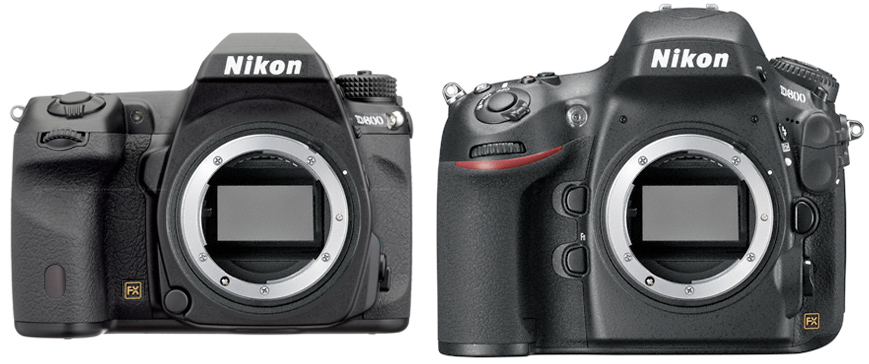
Nikon D800 (right) and a hypothetical more compact D800c full frame camera (left) built along the design principles of the beautiful Pentax K-5 APS-C SLR. The K-5 is smaller than the D800c depicted above.
-- please click to enlarge --
Two years ago, right before the Photokina 2010 trade show, I had a detailed look at a possible trend for full frame cameras:
At that time, full frame was a non issue and until recently, no new full frame camera was released indeed. Mirrorless system cameras (SLD) were the new kids on the block. However, I guessed that SLR camera makers, most notably Pentax, better do some serious homework in 2011 and develop a "24-35 MP full frame SLR with Exmor HD sensor". To be launched before Photokina 2012.

As it turns out, Nikon (and Canon) did exactly this: the remarkable Nikon D800 now takes the enthusiast market by storm. It was meant to be a 2011 release but it was then postponed due to the natural desasters in Japan. And what remains from the enthusiast market may well become victim of the Nikon D600 which is about to launch right before Photokina (Cologne, 2012, September 18 - 23). It is rumored to be priced right where the enthusiast market used to be a couple of years ago. OTOH, Pentax was busy to digest a change of ownership (Hoya to Ricoh) which means nothing but that they lost precious time again.

So, what does it all mean for 2012 and the years to come?

Well, before I start to share my guess work, I'd like to clarify why full frame is an interesting technical proposition at all.


The true reasons for a full frame camera

There is an amazing amount of false information floating around the internet when it comes to the benefits of form factors such as 35 mm full frame or APS-C. Typical examples include statements that full frame equals more shallow depth of field, less noise or unreasonably high sensor cost. Or that APS-C is better because it is good enough in a smaller and less expensive package. Unfortunately, such statements are too simple to be possibly true.

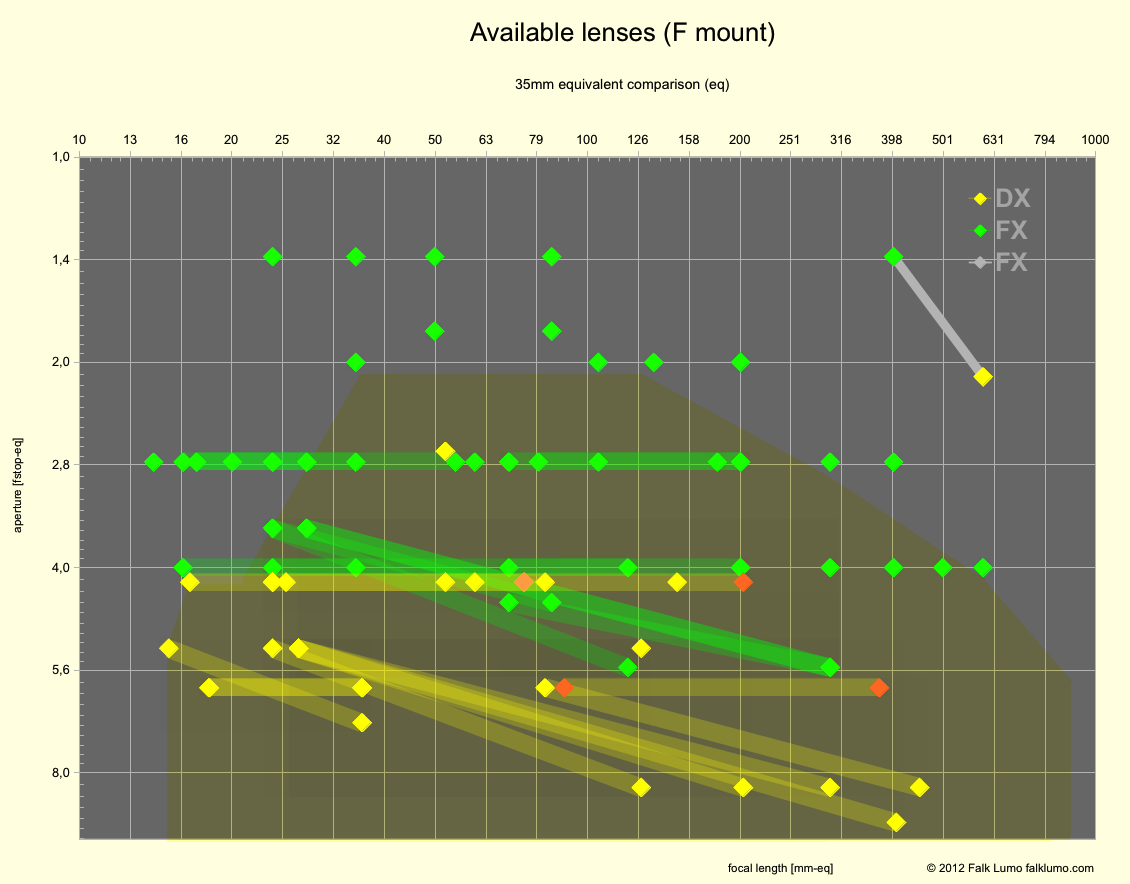
Full frame basically offers more choice or options which may or may not lead to better image quality or other benefits. It is necessary to look at each aspect in somewhat more detail. Therefore, I compiled a LumoLabs white paper listing the true reasons in favour of a full frame or APS-C camera:
Available interchangeable lens options (in 35-mm equivalent terms) for cameras with 35-mm or APS-C sensor, resp. Shown with an emphasis on Nikon. Fig. from the white paper "The true reasons for a full frame camera".
-- please click to enlarge --
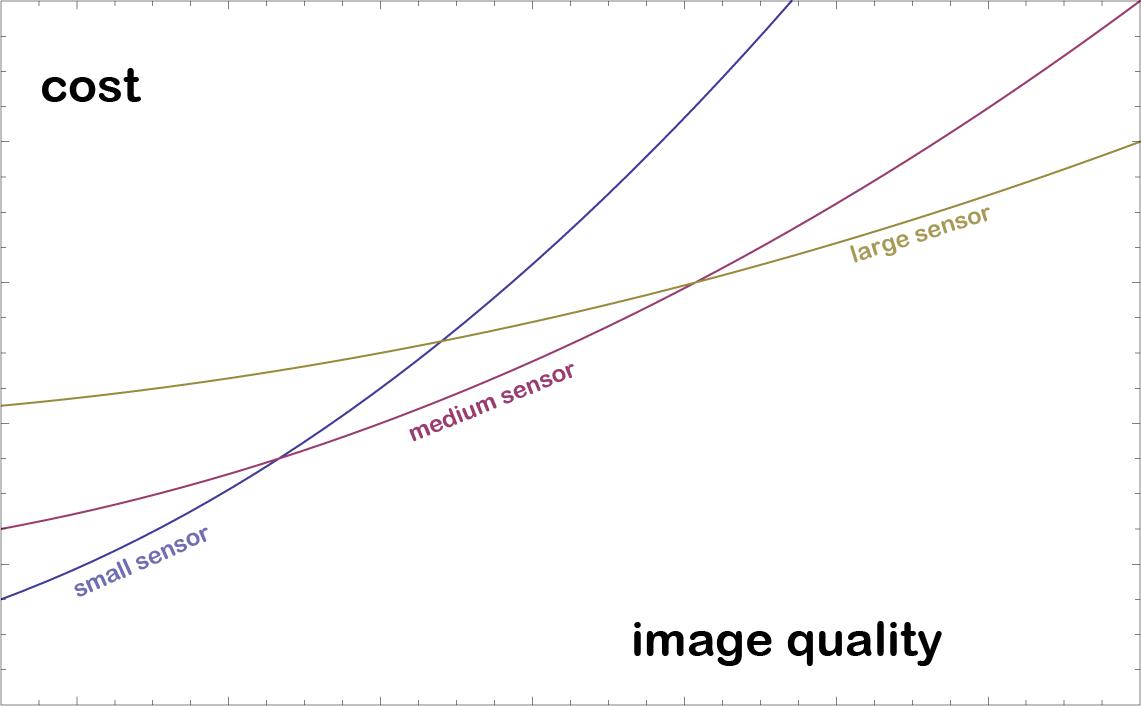
In a nutshell and citing the paper's conclusion, full frame cameras, esp. full frame digital SLRs, are a good option to obtain premium image quality. I explained why there is a sweet spot of image quality where full frame cameras deliver the most cost-efficient solution today. And this is why their market impact must be increasing rapidly.
Cost vs. performance for various sensor formats. Fig. from the white paper "The true reasons for a full frame camera".
-- please click to enlarge --
I believe that the region where a 35 mm full frame sensor is the sweet spot may be expressed today as the region of images with between 20 and 50 clear mega pixels. At lower resolution requirements, I think APS-C still provides the better alternative and above it may be medium format. The Nikon D800 sits right in the middle of this region and this may explain why it is such a smash hit.

Moreover, I think that the region of premium image quality will remain the domain of SLRs for quite a while. Because lenses aren't that small anyway and the optical viewfinders are harder to beat (they are hard to beat anyway when it comes to low light and fast action). This means that every SLR maker will ultimately have to offer a compelling range of full frame cameras and lenses (in order to stay SLR maker).

Statements derived from the above white paper I am going to use here include:
  • There is a level of maximum image quality where full frame offers no benefit over APS-C. At that level, images from full frame and APS-C cameras are basically indistinguishable. And at that level, the weight and price difference between both types of cameras is small (technically speaking).
  • There is a level of image quality which corresponds to printout sizes of approx. DIN A2 or 16" x 24" where full frame cameras (today) offer the better price/performance ratio (technically speaking) or the only option (practically speaking).
  • There are some niche applications (single image HDR, very low available light, fast and accurate focus, portrait/very shallow depth of field) where full frame cameras are clearly better.
  • There are (fewer) niche applications (sports) where an APS-C or a low pixel count (or a fast crop mode) full frame camera still is a better choice.
I confine my consideration to APS-C vs. full frame. The reason is simple: other formats don't share the same mount. And larger or smaller formats currently slightly lack in terms of implementation. E.g., you may look at the current score board leaders at dxomark.com , using tscore = dxoscore + 30 x log_2(crop-factor) as format-independend technology index (the DxO score increases by 15 per EV stop of performance):
  • Medium format (Phase One IQ180, Pentax 645D): tscore = 72
  • Full Frame (Nikon D800E): tscore = 96
  • APS-C (Pentax K-5): tscore = 100
  • FourThirds (Panasonic Lumix DMC GH2): tscore = 90
Therefore, APS-C and full frame cameras perform almost equal when using equivalent lenses (with a possible difference in effective resolution). Other formats (or Canon) currently perform a bit lesser, when compared to cameras equipped with the Sony Exmor column-parallel ADC sensors.


Photokina 2012 and the full frame mystery

By "full frame mystery" I describe the fact that the APS-C dSLR was originally introduced (in 1998/DCS520 $12,000) as a temporary technical compromise in order to make a digital SLR feasible at all. And 35 mm full frame was introduced when that was feasible then (in 2000/Contax-ND $6,500, and Photokina 2002/Canon-1Ds $8,000/Kodak-14n $4,000).

But for no known reason, the market separation between entry-level SLR (APS-C) and pro-level SLR (full frame) has become a non-moving barrier. Around 2008 (3 years after the 5D) it should have reached and moved out of the $1,500 enthusiast camera segment. As described in the white paper above, there are no good technical reasons to explain why it did not happen. Including the manufacturing price differences which faded away, compared to what they have been initially. Today, the manufacturing price difference shouldn't be more than a few hundred $ (own research, would be the topic of a different blog article).

I assume two reasons which are responsible for this mysterious phenomenon:
  1. Market separation: Spreading information (sometimes misleading, esp. from Canon), how expensive it would be to make a full frame sensor, vendors have been able to sell cheap APS-C cameras w/o cannibalizing their revenue from expensive pro gear. Customers trusting such statements never "asked" for more, or accepted a premium price for full frame.
  2. The differences between APS-C and full frame (other than missing equivalent lens options) may not have been significant between about 10 and 20 MP. Therefore, the "good enough" argument applies to some extent.
Therefore, I claim (and actually already claimed in my 2010 article) that by 2012 there is an artificial separation between the APS-C and full frame markets. Artificial because less people still believe that full frame must be expensive. And artificial because image qualities beyond an effective resolution of 20 MP may simply require full frame. The new offers from Nikon (D800 and D600) therefore directly address this and may accelerate the disappearence of the artificial market separation. This is known as "supercriticality": the market ought to offer uncrippled, full frame enthusiast cameras in the $1,500 segment but offers APS-C cameras instead. Supercritical systems "fall" into their preferred state after only small perturbations occur. Once this happens, a D800 type camera will be in the $1,500 segment.

I believe we're going to see things unfold now:

While Photokina 2010 was dominated by the event of mirrorless (SLD) cameras, Photokina 2012 may start a trend for dSLRs to be full frame (only). This assumes that the entry level below $1,000 can't be defended by APS-C SLRs: the competition from SLDs (1" to APS-C) and large sensor compacts (1" etc.) may become too intense and the accuracy problems of APS-C phase-AF beyond 20 MP may start to become a problem.

On the other hand, I don't expect SLRs to disappear any time soon. A good optical viewfinder is almost impossible to beat in the next couple of years and hybrid viewfinders may bring some of the benefits of SLDs to SLRs.

Therefore, I speculate that four things are going to happen until Photokina 2014:
  1. Full frame SLRs become mainstream above $1,000, in a more compact form factor.
  2. Hybrid viewfinders combine the best of two worlds in high end SLRs.
  3. Mirrorless SLDs and large sensor compact cameras dominate the segment between $500 and $1,000, mobile phones below.
  4. Full frame SLDs emerge.
Of course, this means that the cameras with a full frame mount but a half frame sensor become what they meant to be: a curiosity of the past. The full frame mystery will eventually be obsolete. Let's check back before Photokina 2014 ;)


And Pentax ? ... ;)

Long time followers of my blog know that I have quite some sympathy for Pentax. Pentax, 10x smaller than Nikon or Canon but with products challenging the most popular cameras of the big two. E.g., I consider the Pentax K-5 to be a better camera than the Nikon D7000: similiar, but more beautiful, more ergonomic and more fun to use. This is why I would be very disappointed to see Pentax and their K mount continue to fade away as it did in the past since the arrival of the K10D.

Pentax, now having lost half of their enthusiast user base, cannot wait until Photokina 2014 to join what then will be the full frame SLR bandwagon. Their remaining enthusiast users can't wait: the jump in image quality from, say a K-5 to say, a D800 is too dramatic to be ignored. I cannot imagine that Ricoh has bold plans for the K mount but then doesn't come to the same conclusion. Therefore, I assume Pentax to at least "leak" information around Photokina 2012 wrt their own plans. Speculation goes they release a full frame SLR with the Sony A99 sensor in 2013. They better do. The K mount has no future as APS-C only. Esp. as the mirrorless K mount bodies (K-0x) make much more sense with full frame.

CU @ PK12 :)

April 7, 2012

LumoLabs: Nikon D800 video function demystified

Nikon D800 FX mode 1080p video frame (click for original size)
The Nikon D800 full frame SLR camera has created a lot of buzz recently. Some would call it hype. While it is clear that its 36 MP still resolution is pretty much unparalled in the 35mm camera class, the final verdict about its video subsystem is still out. Esp. in comparison with Canon's 5DmkIII.

One point of interest has been how either camera actually creates its video frames. I now had a chance to apply LumoLabs' testing methology to a loaner D800 camera and figure it out for 1080p video in FX mode. I am having a look at live view performance too.

You may jump to the conclusion at the end if you just want to read what we found, igoring how we did it :)


Nikon D800 FX mode FullHD 1080p video

The title image shows one frame from a 1080p video taken with the Nikon D800 (in FX mode, it supports a number of crop video modes too). It shows a zone plate test chart which can be used to perform a sampling error frequency analysis.

Please, read falklumo.blogspot.de/2009/10/lumolab-welcome-and-testing-methodology.html to learn more about the testing methodology incl. access to the original of the test chart allowing everybody to replicate my analysis.

There is a bit of (gray colored) moiré from the printing process. This is because scaling and printing of zone plates is a non-trivial art in itself ;) You can actually measure the printer's native resolution by inspecting the printed zone plate chart. Below, you find a photograph of the print (in 14.6 MP resolution) allowing you to determine what moiré patterns are from the printing process actually.

Printed zone plate chart (still shot with a 14.6 MP camera, for reference)

However, all colorful moiré patterns are artefacts introduced by the D800 video system. It allows us to precisely measure how it works. Let's have a close look at the one of the two center discs:

Analyzed region of interest in the D800 video frame

The big discs are constructed such that the 1080p Nyquist frequency emerges at its outer circle. The two center discs have their edge at twice this Nyquist frequency and the four tiny discs at four times this frequency. Therefore, the false color moiré disc emerges at (149px/258px x2) or 1.155x the 1080p Nyquist frequency (1247 px). This means that the Nikon D800 samples ~1247 horizontal lines from its sensor.

Now, let's make a back-of-the envelope calculation:

An FX frame in video mode is taken from a 6720 x 3780 px region (which actually is a 1.095x crop from the full 7360 x 4912 px frame (this information is from the Nikon user guide, translating physical dimensions into pixels). Because 3780 / 1247 = 3.03 and because 1% is our measurement error, we have proof that the Nikon D800 samples every third horizontal line from its sensor.

A second result is that the ever so slightly color moiré for horizontal frequencies disappears at the Nyquist frequency. The D800's AA filter is effective here, the remaining moiré is from the printing. The D800E would have a bit of additional color moiré here, but by far not as strong as in the vertical direction. So, I believe that the Nikon D800 samples every vertical row from its sensor.

Below is what I believe how Nikon implemented line skipping:

Likely D800 sensel sampling matrix

and here is a slightly more symmetrical scheme which I cannot entirely exclude although I think it isn't used in this mode:
Unlikely sensel sampling matrix
If you look at the likely sensel sampling matrix, you'll see that all sensels which are read out (the ones with a color) result in a new RGGB Bayer matrix of sensels. Which has the advantage that a standard demosaicing algorithm is applicable to create an RGB frame.

This is similiar to what the Canon 5DmkII did actually. However, there is one important aspect where the D800 is different:

A native 1080p video frame is 6720 x 1260 px, demosaiced to a 2240 x 1260 px RGB frame.

And the final 1080p video frame is further downsampled 7:6 to 1960 x 1080 px which gives the D800 a slight edge in resolution and edge flicker behaviour over a 5DmkII.


High ISO noise in video

What we found has one important consequence: High ISO noise in video! Because of the FX video crop and skipping two thirds of sensels, the ISO performance in video is shifted by a factor 3.60. E.g., At ISO 12,800, the noise looks (as bad) as at ISO 46,000 from a camera using all available sensors for video (except for the 16:9 ratio crop of course).

You may note however, that the D800 still samples 6720 x 1260 sensels for a 1920 x 1080 frame or 4.08 sensels per pixel. For this reason, at ISO 12,800, the noise looks (as good) as at ISO 3,200 from a still image when pixel peeping at a 100% (1:1) level. So, pixel noise in D800 video is 2 stops less compared to still while it could have been 3.85 stops less when reading out a maximum of sensels. If you consider this bad or good is up to you.

Below, I have extracted frames from the ISO comparison performed by crisislab.com:

Video noise comparison D800 vs. 5DmkIII -- original frames (c) 2012 crisislab.com
On the left hand stripe, I have shifted the D800 samples two stips down and I think, it is a good match for the 5DmkIII performance then.

From that, I can already conclude that the 5DmkIII reads out all its sensels, i.e., does no line skipping. However, I didn't run a resolution analysis for the 5DmkIII. However, hearing about resolution complaints for 5DmkIII video, I think they bin pixels before read out. This improves noise and aliasing performance but unlike downsampling, doesn't help the resolution.


Nikon D800 Live View implementation notes

I have applied our testing methodology to Nikon's live view implementation too.

D800 live view, photograph of the rear LCD (no zoom level)
You see the same false color moiré discs which we have analyzed already. Of course, there is some strong additional moiré from the LCD rasterization. I.e., the D800 only reads every third line when activating live view (in the example, it is FX video live view).

If we zoom in, we get a result as follows.

D800 live view, photograph of the rear LCD (high zoom level)
You now different false color moiré disc, they have moved outwards. The sampling frequency is  (1692px/1935px x2) or 1.749x the 1080p Nyquist frequency (1889 px). Because 3780 / 1889 = 2.00, we have proof that the Nikon D800 samples every second horizontal line from its sensor when zooming enough in live view.

In live view, the D800 switches from third line to second line skipping when zooming in!

Lessons for manual focusing: (1) zoom in and (2) focus onto vertical structures which have twice the resolution in live view! Focus on trees, edges of buildings rather than horizon or roof top.


Conclusion

The D800 creates FX 1080p video in the following way:
  1. Crop a region of 6720 x 3780 sensels (crop factor 1.095).
  2. Read only every third line out of this region, but all sensels in a line. The result is an 6720 x 1260 sensel RGGB Bayer pattern which can be demosaiced.
  3. The resulting 2240 x 1260 RGB image is downsampled 7:6 to the final 1920 x 1080 px resolution.
  4. Compared to an optimum architecture, only 1/3.6 of sensels are read which makes the D800 loose up to 1.8 stops in high ISO video performance.
  5. When zooming into a live view image, the D800 switches line skipping from 3x to 2x.
  6. Manual forcus should use zoomed live view focusing vertical edges.
Overall, I am personally pleased with the implementation Nikon has chosen. It refines an idea originally used in the 5DmkII which is more difficult to implement due to the higher overall number of pixels. Because of downsampling from 1260p to 1080p, I actually expect slightly better resolution than from a 5DmkII or a camera which bins sensels prior to demosaicing.

On the other hand, there will be no more excuses for line skipping in the future. Not after Nokia got rid of it in their 41 MP 808 mobile phone ...


Enjoy your read :)
Falk

December 11, 2009

Lumolabs: Sensors of Nikon D700, D5000 and Pentax K-x


(Photo ©2009 Karsten Pawlik.)

After the interesting findings about the relatively good dynamic range properties of the Pentax K-x (cf. Lumolabs: Pentax K-x sensor quality), many have requested to publish a comparison with some other well known camera models.

Well, I am happy to announce that a great photographer and dear friend of mine, Karsten Pawlik (kafenio.org) shares my passion and we could spend some time in studio together in order to compile this comparison.

Most of the photos (e.g., all Nikon photos) presented in this article are © Karsten Pawlik. The opening photo shows two Pentax K-x with the gorgeous Pentax FA 31/1.8 Limited lens, in both black and silver color.

It is interesting to compare the K-x with these two cameras from Nikon for the following reasons:


  1. Nikon D5000 and Pentax K-x may share the same Sony Exmor sensor which is supposed to be found in the Sony A500 too. (well, maybe not: DxO measures that the A500 has a different sensor)
  2. Nikon D700 is a full frame camera and captures 1.2 stops more light than both the Nikon D5000 and Pentax K-x which are both APS-C only. It is interesting to see if this advantage shows in images.


1. ISO Noise


(please click on the photo above (and all others) for better readable versions)

The above chart summarizes the noise levels for 18% gray patches (2800 °K tungsten) at various values for ISO: 100, 1600 and 12800, measured as a signal to noise ratio (SNR [dB]). Please read Lumolabs: Welcome and testing methodology for details about how we measure these values. Towards the end of this article, you'll find links to all original test shots suitable for further examination.

Within this article, I will ignore the fact that the D5000 delivered the best SNR at ISO 100. AT ISO1600, we see the expected result: About 3dB or 1 f-stop (1EV) advantage for the full frame D700 with respect to both D5000 and K-x.

At ISO 12800, the K-x manages to match the result of the D700 while the D5000 behaves as expected. However, the SNR should decrease by at least 9dB when going from ISO 1600 to 12800 while it only decreases by only about 6dB for the K-x. This is a sign for raw file noise reduction at work for the Pentax and I believe that all SNR values for Pentax K-x should be reduced by 3dB for ISO values of 3200 or higher.

(Note: The D5000 has no native setting of ISO 12800. It was emulated using ISO 6400 and exposing like for ISO 12800, pushing 1 stop in postprocessing.)

In summary, we confirm the 1 stop advantage for the full frame sensor as far as high iso gray level noise is concerned.


2. Dynamic range

The situation turns out to be more complicated when we study the respective dynamic ranges. Let's start with the full SNR curves for all cameras.


Look first at the three red (D700 full frame), blue (D5000) and green (K-x) curves in the middle of the graph: These are the ISO 1600 curves for the three camera models and the red line lying above the others shows the full frame advantage we have been talking about above. The curves show how the signal-to-noise ratio decreases (relative noise increases) towards the shadows (the lower luminosities towards the left). At ISO 1600, the full frame advantage remains significant throughout all luminosities spanning 7 stops (1%). Note that the curves at ISO12800 may be "polluted" by noise reduction tricks for the APS-C sensors.

Most important for the determination of dynamic range are the SNR curves at lowest ISO (i.e., ISO 100). In order to measure deepest shadow noise, we made three shots at ISO100: normal, underexposed by -5EV and underexposed by -10EV! Patches from all three shots were analyzed to compile an SNR curve spanning 13 stops (down to 0.02% luminosity (which is RGB 0.05/255 and sRGB 0.6/255 aka perfect black)).

The surprising result is that at deepest shadows, the D5000 outperform the D700 by 2 dB and the K-x by even 5 dB. This should translate to about 0.5 EV more dynamic range for the D5000, and about 1.5 EV more dynamic range for the K-x, when compared to the D700. DxO does indeed confirm more dynamic range for the D5000 (12.5EV) compared to D700 (12.2EV). In combination, this is a confirmation for the "13EV or better" dynamic range claim I made in my earlier blog article.


3. Dynamic range (revisited)

I decided that this isn't the full story. Numeric results of measurements of noise are one thing. Plausibility checks are another.

(you must click the image and then select "O" (original size) to use this chart!)

The above chart contains various (small) noise patches from all cameras and ISO values. I even added some Pentax K-7 patches for comparison (Note: the K-7 has more pixels). Towards the end of this article, you'll find links to all original test shots suitable for further examination.

A quick examination of the patches at ISO 100 and -10EV shows that the D700 wins hands-down: better color accuracy, better readability of letters and better contrast. It sure looks slightly more busy (more noise) but the noise looks more fine grain too. More fine grain? Yes, the noise from the D5000 and K-x look coarser than the noise from the D700 or K-7. But noise should be statistically uncorrelated and look always fine grain (except for pattern noise).

Good detail note: all three cameras have no visible pattern noise.

Obviously, the sensor of the Nikon D5000 and Pentax K-x (and I guess it is the sensor rather than the firmware) plays some tricks with the signal in deepest shadows: there seems to be some sort of deep shadow noise reduction at work (like binning dark pixels) which leads to softer detail and a lower noise measurement.

Therefore, I conclude that the excellent dynamic range measurements of the D5000 and K-x are partly due to sophisticated signal processing, possibly on the sensor itself.

However, even taking this disclaimer into account, we can say that the deepest shadow reproduction of all three cameras play in one league: e.g., look at the 153 letters in the -10EV samples and compare to the K-7 (-9EV only) where the letters aren't legible anymore.

I conclude that by dynamic range, taking all information into account, the cameras rank as follows:


  1. Nikon D700 (#3 by lab test)
  2. Pentax K-x (#1 by lab test) and
    Nikon D5000 (#2 by lab test)

and are all very close.

The ISO12800 patches roughly confirm the numeric lab results. A K-x at ISO12800 and a K-7 at ISO6400 do roughly have the same noise while the K-7 keeps a slight resolution advantage even at such high ISO values.


4. Conclusion

Traditionaly, there is a one stop difference between full frame and APS-C. Temporarily, this sensor (Nikon D5000, Pentax K-x, supposed to be a Sony Exmor sensor) fills the gap (towards a Nikon D700) with respect to dynamic range while the difference remains with respect to high ISO noise.

This means that the D5000/K-x sensor has the same sensitivity to light as usual (as the D700) but has significantly reduced read-out noise.

The Pentax K-x may have a slight advantage over the Nikon D5000, esp. at very high ISO values. At the same time, this sensor (or firmware library) seems to include raw data alteration which makes the numerical analysis even more difficult, even when done in the DxO way. The time for true signal measurements has come, defining random noise as the sample variations of the signal and fixed pattern noise as the difference of the mean value with the ideal signal.

Lab tests (our own and the ones published by DxO) make the D5000/K-x have better dynamic range than the D700. But this is due to the limited testing methodology. D700 still has the better dynamic range, but by a small margin only.


5. Further reading

Access to full sample shot material:


Enjoy! :)