Navigation

Showing posts with label full frame. Show all posts

July 2, 2012

The full frame mystery revisited

and the true reasons for a full frame camera
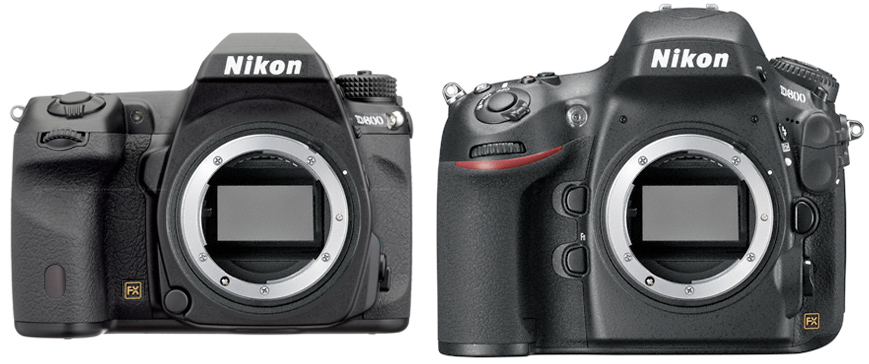
Nikon D800 (right) and a hypothetical more compact D800c full frame camera (left) built along the design principles of the beautiful Pentax K-5 APS-C SLR. The K-5 is smaller than the D800c depicted above.
-- please click to enlarge --
Two years ago, right before the Photokina 2010 trade show, I had a detailed look at a possible trend for full frame cameras:
At that time, full frame was a non issue and until recently, no new full frame camera was released indeed. Mirrorless system cameras (SLD) were the new kids on the block. However, I guessed that SLR camera makers, most notably Pentax, better do some serious homework in 2011 and develop a "24-35 MP full frame SLR with Exmor HD sensor". To be launched before Photokina 2012.

As it turns out, Nikon (and Canon) did exactly this: the remarkable Nikon D800 now takes the enthusiast market by storm. It was meant to be a 2011 release but it was then postponed due to the natural desasters in Japan. And what remains from the enthusiast market may well become victim of the Nikon D600 which is about to launch right before Photokina (Cologne, 2012, September 18 - 23). It is rumored to be priced right where the enthusiast market used to be a couple of years ago. OTOH, Pentax was busy to digest a change of ownership (Hoya to Ricoh) which means nothing but that they lost precious time again.

So, what does it all mean for 2012 and the years to come?

Well, before I start to share my guess work, I'd like to clarify why full frame is an interesting technical proposition at all.


The true reasons for a full frame camera

There is an amazing amount of false information floating around the internet when it comes to the benefits of form factors such as 35 mm full frame or APS-C. Typical examples include statements that full frame equals more shallow depth of field, less noise or unreasonably high sensor cost. Or that APS-C is better because it is good enough in a smaller and less expensive package. Unfortunately, such statements are too simple to be possibly true.

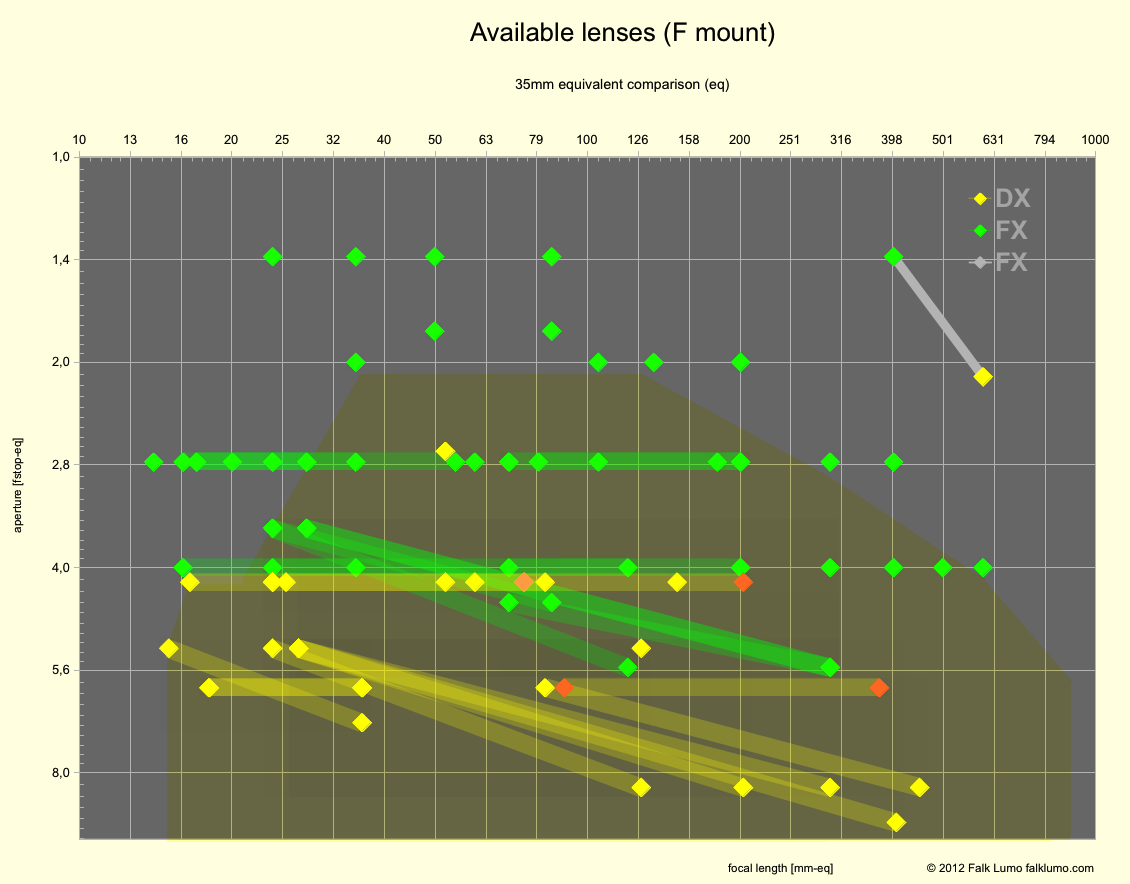
Full frame basically offers more choice or options which may or may not lead to better image quality or other benefits. It is necessary to look at each aspect in somewhat more detail. Therefore, I compiled a LumoLabs white paper listing the true reasons in favour of a full frame or APS-C camera:
Available interchangeable lens options (in 35-mm equivalent terms) for cameras with 35-mm or APS-C sensor, resp. Shown with an emphasis on Nikon. Fig. from the white paper "The true reasons for a full frame camera".
-- please click to enlarge --
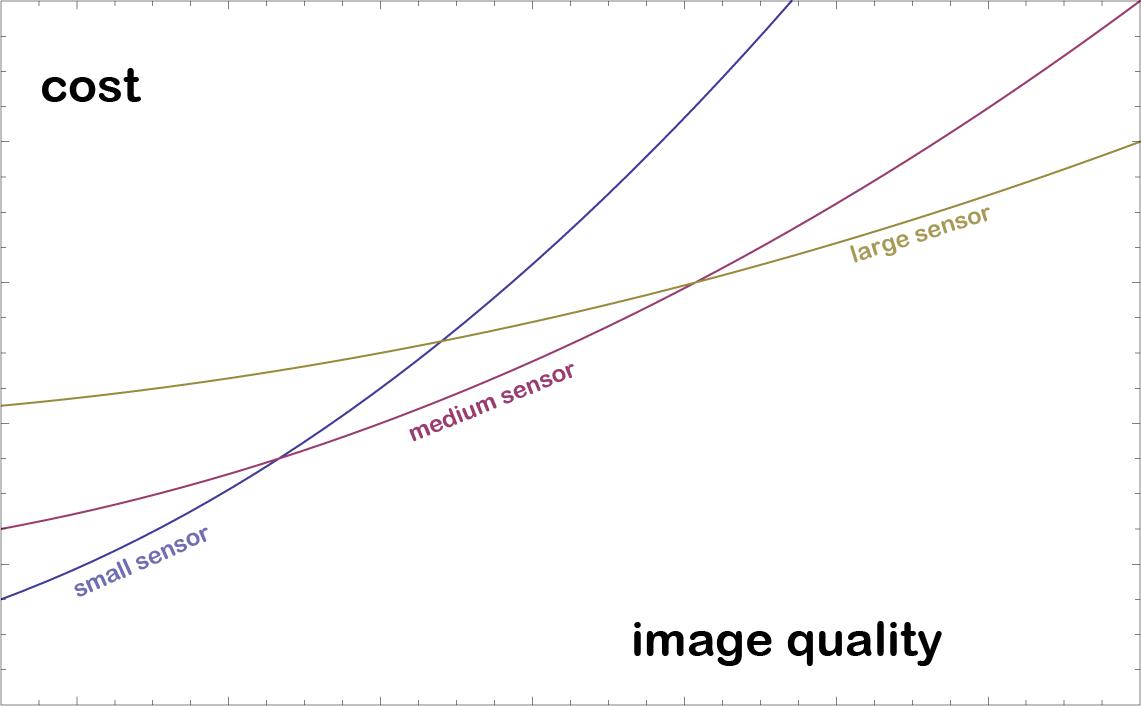
In a nutshell and citing the paper's conclusion, full frame cameras, esp. full frame digital SLRs, are a good option to obtain premium image quality. I explained why there is a sweet spot of image quality where full frame cameras deliver the most cost-efficient solution today. And this is why their market impact must be increasing rapidly.
Cost vs. performance for various sensor formats. Fig. from the white paper "The true reasons for a full frame camera".
-- please click to enlarge --
I believe that the region where a 35 mm full frame sensor is the sweet spot may be expressed today as the region of images with between 20 and 50 clear mega pixels. At lower resolution requirements, I think APS-C still provides the better alternative and above it may be medium format. The Nikon D800 sits right in the middle of this region and this may explain why it is such a smash hit.

Moreover, I think that the region of premium image quality will remain the domain of SLRs for quite a while. Because lenses aren't that small anyway and the optical viewfinders are harder to beat (they are hard to beat anyway when it comes to low light and fast action). This means that every SLR maker will ultimately have to offer a compelling range of full frame cameras and lenses (in order to stay SLR maker).

Statements derived from the above white paper I am going to use here include:
  • There is a level of maximum image quality where full frame offers no benefit over APS-C. At that level, images from full frame and APS-C cameras are basically indistinguishable. And at that level, the weight and price difference between both types of cameras is small (technically speaking).
  • There is a level of image quality which corresponds to printout sizes of approx. DIN A2 or 16" x 24" where full frame cameras (today) offer the better price/performance ratio (technically speaking) or the only option (practically speaking).
  • There are some niche applications (single image HDR, very low available light, fast and accurate focus, portrait/very shallow depth of field) where full frame cameras are clearly better.
  • There are (fewer) niche applications (sports) where an APS-C or a low pixel count (or a fast crop mode) full frame camera still is a better choice.
I confine my consideration to APS-C vs. full frame. The reason is simple: other formats don't share the same mount. And larger or smaller formats currently slightly lack in terms of implementation. E.g., you may look at the current score board leaders at dxomark.com , using tscore = dxoscore + 30 x log_2(crop-factor) as format-independend technology index (the DxO score increases by 15 per EV stop of performance):
  • Medium format (Phase One IQ180, Pentax 645D): tscore = 72
  • Full Frame (Nikon D800E): tscore = 96
  • APS-C (Pentax K-5): tscore = 100
  • FourThirds (Panasonic Lumix DMC GH2): tscore = 90
Therefore, APS-C and full frame cameras perform almost equal when using equivalent lenses (with a possible difference in effective resolution). Other formats (or Canon) currently perform a bit lesser, when compared to cameras equipped with the Sony Exmor column-parallel ADC sensors.


Photokina 2012 and the full frame mystery

By "full frame mystery" I describe the fact that the APS-C dSLR was originally introduced (in 1998/DCS520 $12,000) as a temporary technical compromise in order to make a digital SLR feasible at all. And 35 mm full frame was introduced when that was feasible then (in 2000/Contax-ND $6,500, and Photokina 2002/Canon-1Ds $8,000/Kodak-14n $4,000).

But for no known reason, the market separation between entry-level SLR (APS-C) and pro-level SLR (full frame) has become a non-moving barrier. Around 2008 (3 years after the 5D) it should have reached and moved out of the $1,500 enthusiast camera segment. As described in the white paper above, there are no good technical reasons to explain why it did not happen. Including the manufacturing price differences which faded away, compared to what they have been initially. Today, the manufacturing price difference shouldn't be more than a few hundred $ (own research, would be the topic of a different blog article).

I assume two reasons which are responsible for this mysterious phenomenon:
  1. Market separation: Spreading information (sometimes misleading, esp. from Canon), how expensive it would be to make a full frame sensor, vendors have been able to sell cheap APS-C cameras w/o cannibalizing their revenue from expensive pro gear. Customers trusting such statements never "asked" for more, or accepted a premium price for full frame.
  2. The differences between APS-C and full frame (other than missing equivalent lens options) may not have been significant between about 10 and 20 MP. Therefore, the "good enough" argument applies to some extent.
Therefore, I claim (and actually already claimed in my 2010 article) that by 2012 there is an artificial separation between the APS-C and full frame markets. Artificial because less people still believe that full frame must be expensive. And artificial because image qualities beyond an effective resolution of 20 MP may simply require full frame. The new offers from Nikon (D800 and D600) therefore directly address this and may accelerate the disappearence of the artificial market separation. This is known as "supercriticality": the market ought to offer uncrippled, full frame enthusiast cameras in the $1,500 segment but offers APS-C cameras instead. Supercritical systems "fall" into their preferred state after only small perturbations occur. Once this happens, a D800 type camera will be in the $1,500 segment.

I believe we're going to see things unfold now:

While Photokina 2010 was dominated by the event of mirrorless (SLD) cameras, Photokina 2012 may start a trend for dSLRs to be full frame (only). This assumes that the entry level below $1,000 can't be defended by APS-C SLRs: the competition from SLDs (1" to APS-C) and large sensor compacts (1" etc.) may become too intense and the accuracy problems of APS-C phase-AF beyond 20 MP may start to become a problem.

On the other hand, I don't expect SLRs to disappear any time soon. A good optical viewfinder is almost impossible to beat in the next couple of years and hybrid viewfinders may bring some of the benefits of SLDs to SLRs.

Therefore, I speculate that four things are going to happen until Photokina 2014:
  1. Full frame SLRs become mainstream above $1,000, in a more compact form factor.
  2. Hybrid viewfinders combine the best of two worlds in high end SLRs.
  3. Mirrorless SLDs and large sensor compact cameras dominate the segment between $500 and $1,000, mobile phones below.
  4. Full frame SLDs emerge.
Of course, this means that the cameras with a full frame mount but a half frame sensor become what they meant to be: a curiosity of the past. The full frame mystery will eventually be obsolete. Let's check back before Photokina 2014 ;)


And Pentax ? ... ;)

Long time followers of my blog know that I have quite some sympathy for Pentax. Pentax, 10x smaller than Nikon or Canon but with products challenging the most popular cameras of the big two. E.g., I consider the Pentax K-5 to be a better camera than the Nikon D7000: similiar, but more beautiful, more ergonomic and more fun to use. This is why I would be very disappointed to see Pentax and their K mount continue to fade away as it did in the past since the arrival of the K10D.

Pentax, now having lost half of their enthusiast user base, cannot wait until Photokina 2014 to join what then will be the full frame SLR bandwagon. Their remaining enthusiast users can't wait: the jump in image quality from, say a K-5 to say, a D800 is too dramatic to be ignored. I cannot imagine that Ricoh has bold plans for the K mount but then doesn't come to the same conclusion. Therefore, I assume Pentax to at least "leak" information around Photokina 2012 wrt their own plans. Speculation goes they release a full frame SLR with the Sony A99 sensor in 2013. They better do. The K mount has no future as APS-C only. Esp. as the mirrorless K mount bodies (K-0x) make much more sense with full frame.

CU @ PK12 :)

April 7, 2012

LumoLabs: Nikon D800 video function demystified

Nikon D800 FX mode 1080p video frame (click for original size)
The Nikon D800 full frame SLR camera has created a lot of buzz recently. Some would call it hype. While it is clear that its 36 MP still resolution is pretty much unparalled in the 35mm camera class, the final verdict about its video subsystem is still out. Esp. in comparison with Canon's 5DmkIII.

One point of interest has been how either camera actually creates its video frames. I now had a chance to apply LumoLabs' testing methology to a loaner D800 camera and figure it out for 1080p video in FX mode. I am having a look at live view performance too.

You may jump to the conclusion at the end if you just want to read what we found, igoring how we did it :)


Nikon D800 FX mode FullHD 1080p video

The title image shows one frame from a 1080p video taken with the Nikon D800 (in FX mode, it supports a number of crop video modes too). It shows a zone plate test chart which can be used to perform a sampling error frequency analysis.

Please, read falklumo.blogspot.de/2009/10/lumolab-welcome-and-testing-methodology.html to learn more about the testing methodology incl. access to the original of the test chart allowing everybody to replicate my analysis.

There is a bit of (gray colored) moiré from the printing process. This is because scaling and printing of zone plates is a non-trivial art in itself ;) You can actually measure the printer's native resolution by inspecting the printed zone plate chart. Below, you find a photograph of the print (in 14.6 MP resolution) allowing you to determine what moiré patterns are from the printing process actually.

Printed zone plate chart (still shot with a 14.6 MP camera, for reference)

However, all colorful moiré patterns are artefacts introduced by the D800 video system. It allows us to precisely measure how it works. Let's have a close look at the one of the two center discs:

Analyzed region of interest in the D800 video frame

The big discs are constructed such that the 1080p Nyquist frequency emerges at its outer circle. The two center discs have their edge at twice this Nyquist frequency and the four tiny discs at four times this frequency. Therefore, the false color moiré disc emerges at (149px/258px x2) or 1.155x the 1080p Nyquist frequency (1247 px). This means that the Nikon D800 samples ~1247 horizontal lines from its sensor.

Now, let's make a back-of-the envelope calculation:

An FX frame in video mode is taken from a 6720 x 3780 px region (which actually is a 1.095x crop from the full 7360 x 4912 px frame (this information is from the Nikon user guide, translating physical dimensions into pixels). Because 3780 / 1247 = 3.03 and because 1% is our measurement error, we have proof that the Nikon D800 samples every third horizontal line from its sensor.

A second result is that the ever so slightly color moiré for horizontal frequencies disappears at the Nyquist frequency. The D800's AA filter is effective here, the remaining moiré is from the printing. The D800E would have a bit of additional color moiré here, but by far not as strong as in the vertical direction. So, I believe that the Nikon D800 samples every vertical row from its sensor.

Below is what I believe how Nikon implemented line skipping:

Likely D800 sensel sampling matrix

and here is a slightly more symmetrical scheme which I cannot entirely exclude although I think it isn't used in this mode:
Unlikely sensel sampling matrix
If you look at the likely sensel sampling matrix, you'll see that all sensels which are read out (the ones with a color) result in a new RGGB Bayer matrix of sensels. Which has the advantage that a standard demosaicing algorithm is applicable to create an RGB frame.

This is similiar to what the Canon 5DmkII did actually. However, there is one important aspect where the D800 is different:

A native 1080p video frame is 6720 x 1260 px, demosaiced to a 2240 x 1260 px RGB frame.

And the final 1080p video frame is further downsampled 7:6 to 1960 x 1080 px which gives the D800 a slight edge in resolution and edge flicker behaviour over a 5DmkII.


High ISO noise in video

What we found has one important consequence: High ISO noise in video! Because of the FX video crop and skipping two thirds of sensels, the ISO performance in video is shifted by a factor 3.60. E.g., At ISO 12,800, the noise looks (as bad) as at ISO 46,000 from a camera using all available sensors for video (except for the 16:9 ratio crop of course).

You may note however, that the D800 still samples 6720 x 1260 sensels for a 1920 x 1080 frame or 4.08 sensels per pixel. For this reason, at ISO 12,800, the noise looks (as good) as at ISO 3,200 from a still image when pixel peeping at a 100% (1:1) level. So, pixel noise in D800 video is 2 stops less compared to still while it could have been 3.85 stops less when reading out a maximum of sensels. If you consider this bad or good is up to you.

Below, I have extracted frames from the ISO comparison performed by crisislab.com:

Video noise comparison D800 vs. 5DmkIII -- original frames (c) 2012 crisislab.com
On the left hand stripe, I have shifted the D800 samples two stips down and I think, it is a good match for the 5DmkIII performance then.

From that, I can already conclude that the 5DmkIII reads out all its sensels, i.e., does no line skipping. However, I didn't run a resolution analysis for the 5DmkIII. However, hearing about resolution complaints for 5DmkIII video, I think they bin pixels before read out. This improves noise and aliasing performance but unlike downsampling, doesn't help the resolution.


Nikon D800 Live View implementation notes

I have applied our testing methodology to Nikon's live view implementation too.

D800 live view, photograph of the rear LCD (no zoom level)
You see the same false color moiré discs which we have analyzed already. Of course, there is some strong additional moiré from the LCD rasterization. I.e., the D800 only reads every third line when activating live view (in the example, it is FX video live view).

If we zoom in, we get a result as follows.

D800 live view, photograph of the rear LCD (high zoom level)
You now different false color moiré disc, they have moved outwards. The sampling frequency is  (1692px/1935px x2) or 1.749x the 1080p Nyquist frequency (1889 px). Because 3780 / 1889 = 2.00, we have proof that the Nikon D800 samples every second horizontal line from its sensor when zooming enough in live view.

In live view, the D800 switches from third line to second line skipping when zooming in!

Lessons for manual focusing: (1) zoom in and (2) focus onto vertical structures which have twice the resolution in live view! Focus on trees, edges of buildings rather than horizon or roof top.


Conclusion

The D800 creates FX 1080p video in the following way:
  1. Crop a region of 6720 x 3780 sensels (crop factor 1.095).
  2. Read only every third line out of this region, but all sensels in a line. The result is an 6720 x 1260 sensel RGGB Bayer pattern which can be demosaiced.
  3. The resulting 2240 x 1260 RGB image is downsampled 7:6 to the final 1920 x 1080 px resolution.
  4. Compared to an optimum architecture, only 1/3.6 of sensels are read which makes the D800 loose up to 1.8 stops in high ISO video performance.
  5. When zooming into a live view image, the D800 switches line skipping from 3x to 2x.
  6. Manual forcus should use zoomed live view focusing vertical edges.
Overall, I am personally pleased with the implementation Nikon has chosen. It refines an idea originally used in the 5DmkII which is more difficult to implement due to the higher overall number of pixels. Because of downsampling from 1260p to 1080p, I actually expect slightly better resolution than from a 5DmkII or a camera which bins sensels prior to demosaicing.

On the other hand, there will be no more excuses for line skipping in the future. Not after Nokia got rid of it in their 41 MP 808 mobile phone ...


Enjoy your read :)
Falk

February 21, 2012

LumoLabs: Camera equivalence

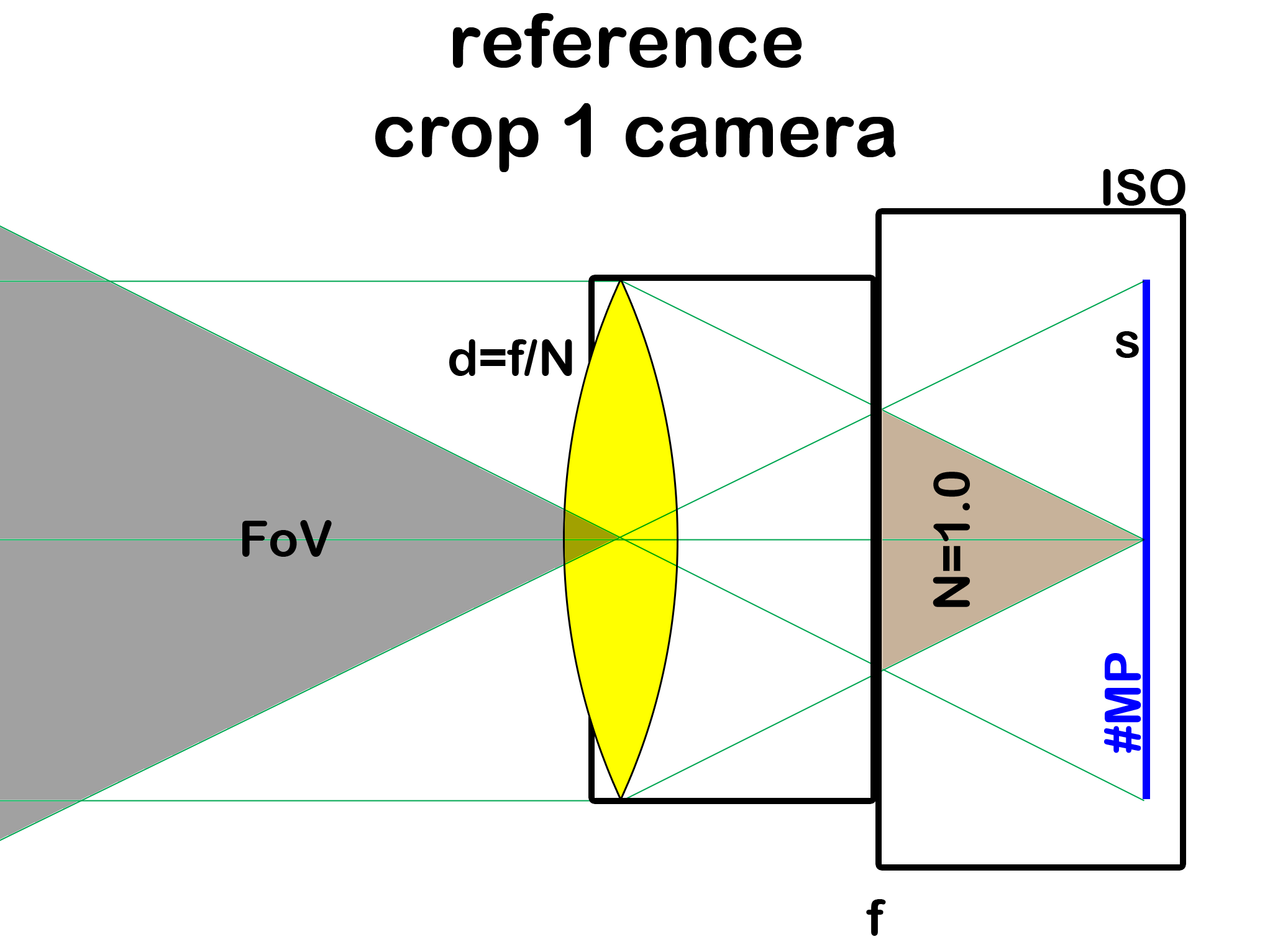
Various parameters, or variables of a real camera or a reference camera are depicted above

In preparation of an article discussing the advantages and disadvantages of various sensor sizes for a given camera performance, I try to set a common ground for such discussions.

I have prepared a white paper which dives much deeper into the topic than is possible in this short blog article. You may find it here:
The short version is this: An image contains no information whatsoever about the size of the sensor within the camera which was used to capture it. None. Nothing. Nada. (except EXIF of course ;) ) The proof is beyond the scope of this blog article and the article only gives some clues. But this is a fact, trust me.

Therefore, all cameras which could have captured a given image create a so-called equivalence class: they are all equivalent, producing indistinguishable images. And they have different sized sensors! By camera, I mean a camera with all the parameters defined it used to capture an image, such as the variables shown in the title image. Changing any variable "creates" a different camera. The exposure time used to capture an image is defined implicitely too: the one giving correct exposure (and it is a constant of course for indistinguishable images).

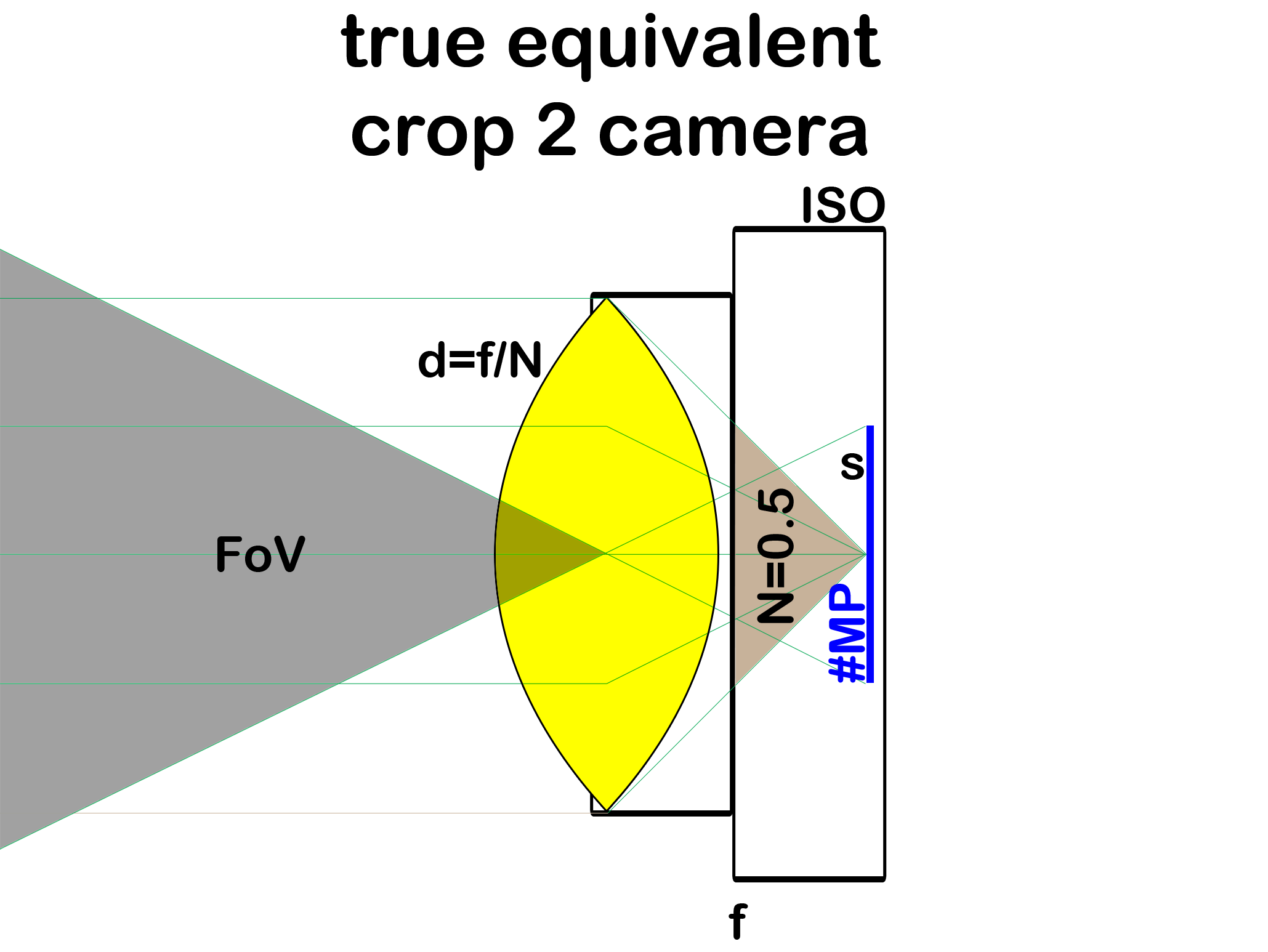
The following image shows an equivalent camera where the sensor has only half the size of the first or reference camera, i.e., an equivalent crop-2 camera:
The camera's lens has the same absolute diameter but it's focal length is shorter to maintain a common field of view. The equivalent crop-2 camera has a different F-stop and ISO sensitivity.


Main claim:

Any discussion about the impact of varying sensor sizes must be based on cameras made equivalent first. Otherwise, any comparison will just reveal the inequivalence of parameters the respective cameras have been set to and nothing else. And such a result would be trivial, known and not worth a further discussion.

Such trivial results are that a larger sensor produces a more shallow depth of field or less image noise. This is not true! Because it just means that the cameras were used with non-equivalent settings, e.g., with lenses of different diameter d which means with lenses of different weight and cost. Another example are ISO comparisons between cameras with different sized sensors but ISO kept the same. Such comparisons are pointless! Instead, compare a FourThirds camera at ISO 100 with a full frame camera at ISO 400 because only then they are equivalent. Not doing so just compares the size of lenses which a ruler can do just as well.


Secondary claim:

Once equivalent cameras are compared, results start to become interesting. Because now any deviation is due to deviations with respect to an ideal camera. Such like a lens with aberrations, production or design tolerances or compromises in a CMOS production process. The white paper explains that such deviations are generally expected to be larger with smaller sized sensors. Of course, one such deviation is obvious: when an equivalent camera doesn't exist for a sensor size, e.g., because an f/0.1 aperture is unfeasible.


I will follow up this article with a more complete article of the impact of sensor size on image quality.

Stay tuned and enjoy your read :)

August 6, 2010

Photokina 2010, Pentax and the full frame mystery


Only a few days left until Photokina 2010


Big Pentax


Or why at this year's 2010 Photokina exhibition, Pentax may not get
away with ignoring the full frame conumdrum.


Many users of digital SLR cameras may not be aware that the sensor in their
camera is smaller than it used to be in the era of 35mm film. Most dSLR cameras
use an APS-C sized sensor which does only have about 40% of the surface of
a "full
35mm film frame
", or "full frame" in short.
Of course, this is expressed by the crop factor and users actually do know
about this. They simply ignore this. And they have reason to do so: the image
quality exceeds that of full frame film cameras and therefore, there seems
to be no reason to care about the detail of sensor size for a dSLR camera.


But as always, there is a school of photograhers who do not agree. It can
be shown that a larger sensor -- when combined with lenses which fully exploit
the design options offered by a larger sensor -- delivers superior image quality.
Independent on how great it was in the first place. After all, it's the reason
of digital medium format cameras to exist. Moreover, the lens mount of all dSLRs
with an APS-C sized sensor is desgned for full frame lenses (lenses with an
image circle large enough to use the entire surface of a full frame sized sensor).
Simply because those mounts are from the 35mm film era. And because it is the
mount (diameter and registration distance) which determines the majority of
the size of an SLR camera, a full frame dSLR wouldn't need to be (significantly)
heavier
or
bulkier
than
an APS-C
dSLR.
Four-Third sized SLR cameras are an exception as their mount isn't full frame
capable. But we can savely ignore it after the impact of this sensor size on
the SLR market has almost vanished after the introduction of Micro Four-Third.


The opening photo is that of a Pentax APS-C dSLR certainly bulkier
than any full frame Pentax film SLR has ever been. Actually, the famous 30+
year old Pentax MX full frame film SLR is smaller than any digital SLR on the
market today, whatever small be its sensor. A full frame dSLR could certainly
be made more compact than the APS-C dSLR shown on the photo above.


So after dismissing the size disadvantage, we are left with only three arguments against a full frame camera which
all disappear on closer inspection, too:


  1. Full frame sensors are too expensive and only pros
    can afford it. Right?


    Well, from public cost models I computed upper bounds
    for
    2010 manufacturing costs for APS-C and full frame sensrs and the difference is
    less than $100 (*) ! Of course, semiconductor vendors will
    add significantly different margins as long as this
    market doesn't heat up.

    (*) Note: for all claims made in this article, look up the "Furter reading" section at the end of the article for further reference.


  2. The lenses are too expensive, bulky and heavy. Right?


    Well, equivalent lenses (different lenses but such that
    they provide equivalent image quality for different
    sized sensors) have the same size and weight for APS-C
    and full frame. And are a bit less expensive
    for full frame! Which is easy to explain by looking
    at lp/mm resolution requirements.


  3. One needs longer, heavier, more expensive tele lenses
    because one looses the crop factor. Right?


    Well, about heavier and more expensive, read above. About
    longer, that's actually a function of the pixel pitch,
    not the crop factor. There is no reason why a full frame
    camera should have a larger pixel pitch than an APS-C
    camera. Currently and for cost reasons only, most actually
    do indeed. Although the difference is already as small as 5µm vs. 6µm. And it is going away. Read about the cost factor above.


So, we are left with a situation where a full frame SLR
should be a no brainer. But as always, things aren't as
simple as they appear.


Market segmentation


Because full frame cameras can deliver better image quality
they appeal to a higher segment of the market. The so-called
enthusiast and professional photographer markets. There
is a hidden consensus between Japanese camera makers (with
maybe the exception of Sony) to draw excessive margins
from the full frame market. Therefore, full frame dSLRs
are either prohibitively expensive (Nikon D3X, Canon 1DsMkIII) or crippled
in one way or another. Sometimes not voluntariliy (Sony).
And they are all bulky and ugly because they have to show
"full frame inside", right? ;)


But despite all the artificial barriers to keep the
markets segmented, more popular models like Canon 5DmkII
or Nikon D700 have risen to 2-3% unit market share each
(estimated from BCN figures). Adding the many professional models from
Canon
and Nikon and the very affordable Sony A850 we have
a unit market share of full frame dSLRs of 5-10%.
Of couse, each new model sends shock waves thru this segmentation
and an upgrade to the D700 is expected
later this year. The figures do also mean that full frame
dSLRs create a significant portion of the vendor's overall
margins,
possibly in excess of 30%.


Overall, the dSLR market is in a state like a supercooled
fluid: the right perturbation and the segmentation will
implode and all but the entry-level SLRs go full frame
(the entry-level SLRs go mirrorless Single Lens Digital
(SLD) anyway...). Think of a full frame Canon 7D or Pentax
K-7 in terms of ergonomics and speed, for well below $1800
settled street price ...


Pentax and the Full Frame mystery


Pentax is an interesting special case. They have not offered
a full frame dSLR yet and always denied any plans to launch
such a camera. On the other hand, Pentax is the brand of
the image quality perfectionist and landscape photographers.
Pentax was the first trying to launch an enthusiast full
frame dSLR, back in the year 2000 (the famous 6MP Pentax
MZ-D), three years before they launched their APS-C dSLR.
They were the first to promote weather sealed bodies and
lenses
for outdoor photography, the first to offer a 15MP APS-C
dSLR (the Pentax K20D) and they are even first to offer
an enthusiast digital medium format SLR below $10,000
(the Pentax 645D). So, they shoud be predestined to offer
the
first
ergonomic
outdoor 20MP+ full frame dSLR in the enthusiast market
segment (~$1200 to ~$1800). This could make
their market share explode.


But there are problems: Pentax burned fingers when trying
to be full frame in 2000. And they burned bridges when
later launching their APS-C only line of dSLRs. Because
for 5 years, they developped APS-C lenses
only and assured the market that their lens investments
are safe because full frame cameras won't come back. In
mid 2008 though, they seem to have changed direction again
and almost no new lenses have been introduced. Two new
lenses, introduced in 2008/2009, the DA*300 and the
DA*60-250/4, are patented as full
frame lenses, actually. So, who knows ... But at least
officially, Pentax is now short in full frame lenses. And
because they never left the decision between APS-C and
full frame to their customers, any announcement about a
forthcoming full frame camera could stall their on-going
business. Well, Pentax may even fear to cannibalize their
new digital medium format business which seems to have
a bright future.


Most importantly though and because they burned fingers
once, Pentax may be convinced that their share of the full
frame market is simply too small, like 5% of 5% or 0.25%
only.


And if deciding to divert development resources, they
may as well decide to invest into the SLD market to protect
their cash cow.


So, when looking at the current or past situation, there
is no reason for Pentax to launch a full frame dSLR camera.
But what about when looking into the future?


This is were the community of Pentax photographers (called
Pentaxians by Pentax) comes into play.


Pentax and the year 2011


2011 will be the year where everybody sells SLD cameras,
Pentax included. Everybody. Pentax will have a genuine
SLD camera. As will Canon and Nikon. But where are buyers
coming from? Well, mostly upgraders from the dying point
& shoot market (in majority shifting to cell phones) and
migraters from equally priced (i.e., entry-level) dSLR.
So, to launch an SLD camera is vital to preserve a market
share in the $400 - $800 segment. Exactly where the Pentax
K-x attracted new buyers to Pentax in the year 2009. But
all
of this doesn't help to preserve the enthusiast (Pentaxian)
market which is the $900 - $1800 segment.


One may argue that the enthusiast market isn't that important
for Pentax from a point of view of turnover. But according
to my own analysis, K-x, K-7 and 645D each create about
the same amount of earnings. Simply because
the mass markets are always small in margin. But most importantly,
blogging Pentaxians are the most influential group: they
are opinion leaders in forums where magazine authors and
store managers draw their opinion from and recommend some
products or not. Unlike in previous years, this group
of opinion leaders has expressed very clearly that they
either expect to see Pentax going full frame in the enthusiast
segment, or leave the brand. I refer to bloggers like LanceB,
once selected "Pentaxian of the year" and who now test
drives a D700 before taking final action.


Pentax is already seeing that Pentaxians put themselves
onto "hold and wait": The sale of expensive DA lenses has
declined while the market for used (full frame) FA and
A lenses is still healthy. This isn't only due to a lack
of new DA* lenses. It is mostly due to the fact that the
enthusiast market drives lens sales and Pentaxians now
assume that the "never be full frame" claim of Pentax lost
its
credibility (due to technical arguments as outlined above).
After all, purchasing a lens is much more kind of an investment
than purchasing a camera which is known to deprecate
fast. The full frame conundrum is already destroying half
of Pentax' business.


So, what would be the right actions to be taken by Pentax
in 2011? Well, first, join the P&S and part of the SLR
team into a new SLD department, delivering the world's
first water-proof SLD and making sure a K-mount adapter
with AF support exists. Drop the P&S division. Pentax'
SLD mount should look as close as possible to Sony's E-mount,
allowing
for
future
35mm SLD cameras. Possibly allowing to sell Pentax lenses
for the E-mount too. I assume the E-mount uses an encrypted
communication protocol. But at least mechanically, there
should be fit.


Second though, form a team from remaining SLR and
645D developers for enthusiast cameras. Their first product
shall be a 24-35MP full frame SLR with Exmor HD
sensor in a K-5* body. Third, release new full frame lenses,
like the DFA 100/Macro relaunched earlier this year.


One may argue that this is infeasible. At least for the
second "enthusiast" team, I don't think so. Assuming Sony
would share their full frame Exmor sensor with Pentax,
all the rest is routine work for Pentax engineers. Moreover,
in June 2008, a Pentax manager said in an interview
that the development of a full frame camera is in its planning
stage. So, if that project wasn't cancelled, it should
be ready to deliver by 2011. Even taking into account that
K-7 and 645D diverted valuable resources in the first 2
years of the 3 year period. Surprisingly, the "leaked"
full frame project coincides with a rush of completed APS-C
DA lenses (2008) and a complete halt to new APS-C
only lens releases from then on and until now (with the
exception of the DA15 lens). Therefore, I guess that Pentax
would have enough full frame lenses to accompany the release
of the camera: FA31, FA43, FA77, DA*55, DA*60-250, DFA100,
DA*200, DA*300. With only 4 additional lenses (DFA28-80
kit zoom, a DFA~18 wideangle prime and two f/2.8 DFA* zooms
(24-70
and
70-200)), the lens line up would be fairly complete. Four
lenses developped or optimized in 3 years, why not?


Pentax and Photokina 2010


Photokina 2010 starts September 21 in Cologne, Germany.
It is the event and everybody is watching
Pentax there (if at all). The internet's rumor mill has
a pretty detailed prediction about what Pentax is going
to reveal: A K-x successor (with focus indicators) and
a new camera positioned above the K-7 but not replacing
it. The first camera named K-r, the second K-5. The K-5
would be APS-C but with a 16MP Sony Exmor sensor, faster
fps (7?) and faster AF system in a body similiar or identical
to that of the K-7. At a price spot at the lower end of
the enthusiast market segment. No full frame. No SLD.


But I sincerely fear that this doesn't suffice. Starting
at Photokina 2010, Pentaxians need a roadmap to full frame
and corresponding lenses in order to be able continue to
invest into their system. They have harvested enough money
now to either invest or migrate elsewhere. And Photokina
2010 will be the checkpoint for many to take action.


To stay silent at Photokina on the full frame front may
imply suicide for Pentax in the mid term.


Pentax can wait until 2011 to say anything about SLD.
People waiting for SLD aren't the opinion leaders so letting
them wait doesn't hurt. Moreover, they can buy any other
SLD w/o leaving the Pentax system. But to disappoint the
enthusiasts now is more dangerous than it ever has been
before. Up to the point that a K-5 would only sell if the
roadmap to full frame is sufficiently clear. Which sounds
paradox but isn't. It's all about psychology and the comfort
zone for what appears to be a hobby for most Pentaxians.
Pentax has to make Pentaxians believe into the brand. That's
part of their job, actually!


So, these are my recommended action items for Pentax at
Photokina 2010:


  • Announce K-5

  • Launch K-r

  • Publish a road-map to full frame, with a first delivery
    in 2011.

  • Launch new lenses, maybe one for APS-C and two for
    full frame.

  • Keep the SLD project a secret.


This article may be read as an open letter to Pentax.
Pentax has no plan to say anything about full frame. Which
is a severe mistake. Seize your chance. If you're too late
to the party, there may
be nobody
left
to become
enthusiast
about
;)
So, keep
people dancing ...


Further reading:


You may use the commenting section to express your endorsement.
Thanks for reading!