Navigation

Showing posts with label Pentax. Show all posts

September 17, 2012

Photokina 2012: First Impressions

Photokina girl showing the new Fuji X-E1 mirrorless with EVF
I have just returned from my first trip thru some of this year's Photokina booths.

First things first: I've met Adam and Oleg from pentaxforums.com and it was great and very enjoyable to assign faces to big names :) They even gave me an official pentaxforums.com shirt which I really enjoyed.

Of course, this is before official opening and most booths and some halls are still blocked, esp. to the to the press. But I had a chance to have a glimpse at most of the recently announced stuff. It is all here :)

July 2, 2012

The full frame mystery revisited

and the true reasons for a full frame camera
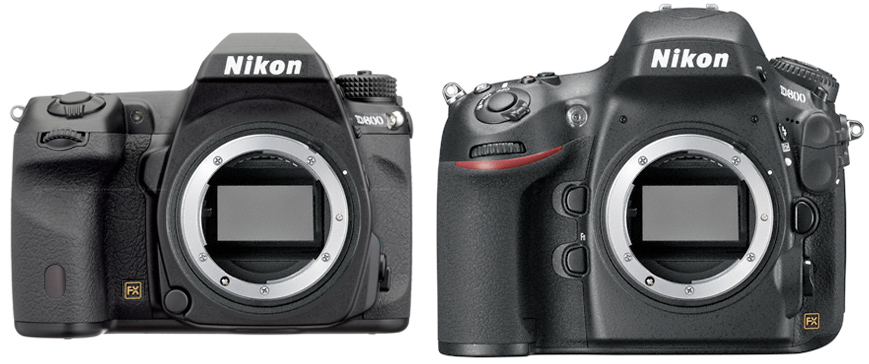
Nikon D800 (right) and a hypothetical more compact D800c full frame camera (left) built along the design principles of the beautiful Pentax K-5 APS-C SLR. The K-5 is smaller than the D800c depicted above.
-- please click to enlarge --
Two years ago, right before the Photokina 2010 trade show, I had a detailed look at a possible trend for full frame cameras:
At that time, full frame was a non issue and until recently, no new full frame camera was released indeed. Mirrorless system cameras (SLD) were the new kids on the block. However, I guessed that SLR camera makers, most notably Pentax, better do some serious homework in 2011 and develop a "24-35 MP full frame SLR with Exmor HD sensor". To be launched before Photokina 2012.

As it turns out, Nikon (and Canon) did exactly this: the remarkable Nikon D800 now takes the enthusiast market by storm. It was meant to be a 2011 release but it was then postponed due to the natural desasters in Japan. And what remains from the enthusiast market may well become victim of the Nikon D600 which is about to launch right before Photokina (Cologne, 2012, September 18 - 23). It is rumored to be priced right where the enthusiast market used to be a couple of years ago. OTOH, Pentax was busy to digest a change of ownership (Hoya to Ricoh) which means nothing but that they lost precious time again.

So, what does it all mean for 2012 and the years to come?

Well, before I start to share my guess work, I'd like to clarify why full frame is an interesting technical proposition at all.


The true reasons for a full frame camera

There is an amazing amount of false information floating around the internet when it comes to the benefits of form factors such as 35 mm full frame or APS-C. Typical examples include statements that full frame equals more shallow depth of field, less noise or unreasonably high sensor cost. Or that APS-C is better because it is good enough in a smaller and less expensive package. Unfortunately, such statements are too simple to be possibly true.

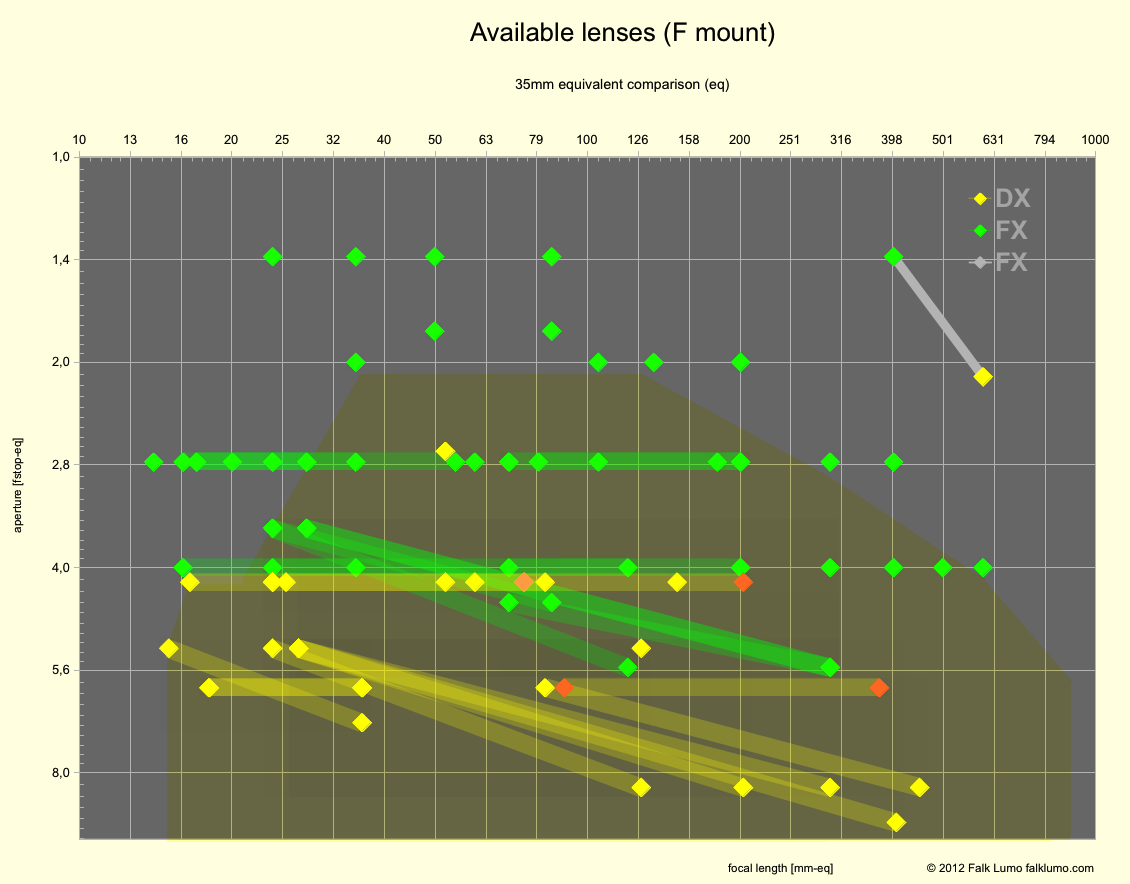
Full frame basically offers more choice or options which may or may not lead to better image quality or other benefits. It is necessary to look at each aspect in somewhat more detail. Therefore, I compiled a LumoLabs white paper listing the true reasons in favour of a full frame or APS-C camera:
Available interchangeable lens options (in 35-mm equivalent terms) for cameras with 35-mm or APS-C sensor, resp. Shown with an emphasis on Nikon. Fig. from the white paper "The true reasons for a full frame camera".
-- please click to enlarge --
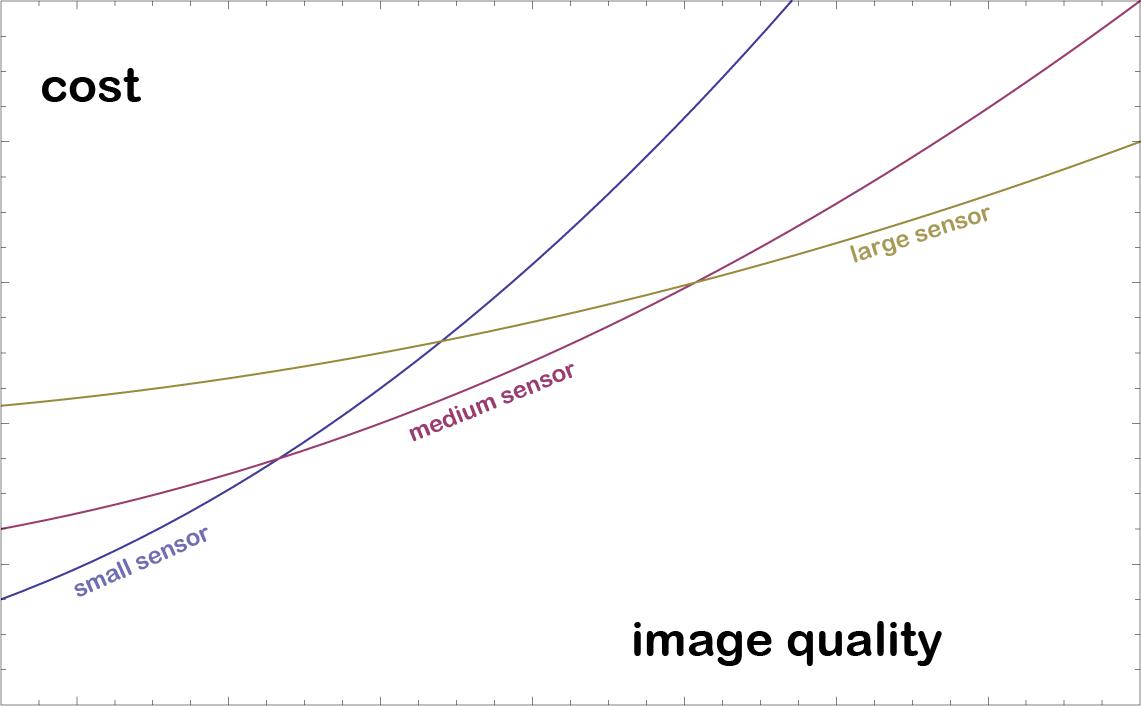
In a nutshell and citing the paper's conclusion, full frame cameras, esp. full frame digital SLRs, are a good option to obtain premium image quality. I explained why there is a sweet spot of image quality where full frame cameras deliver the most cost-efficient solution today. And this is why their market impact must be increasing rapidly.
Cost vs. performance for various sensor formats. Fig. from the white paper "The true reasons for a full frame camera".
-- please click to enlarge --
I believe that the region where a 35 mm full frame sensor is the sweet spot may be expressed today as the region of images with between 20 and 50 clear mega pixels. At lower resolution requirements, I think APS-C still provides the better alternative and above it may be medium format. The Nikon D800 sits right in the middle of this region and this may explain why it is such a smash hit.

Moreover, I think that the region of premium image quality will remain the domain of SLRs for quite a while. Because lenses aren't that small anyway and the optical viewfinders are harder to beat (they are hard to beat anyway when it comes to low light and fast action). This means that every SLR maker will ultimately have to offer a compelling range of full frame cameras and lenses (in order to stay SLR maker).

Statements derived from the above white paper I am going to use here include:
  • There is a level of maximum image quality where full frame offers no benefit over APS-C. At that level, images from full frame and APS-C cameras are basically indistinguishable. And at that level, the weight and price difference between both types of cameras is small (technically speaking).
  • There is a level of image quality which corresponds to printout sizes of approx. DIN A2 or 16" x 24" where full frame cameras (today) offer the better price/performance ratio (technically speaking) or the only option (practically speaking).
  • There are some niche applications (single image HDR, very low available light, fast and accurate focus, portrait/very shallow depth of field) where full frame cameras are clearly better.
  • There are (fewer) niche applications (sports) where an APS-C or a low pixel count (or a fast crop mode) full frame camera still is a better choice.
I confine my consideration to APS-C vs. full frame. The reason is simple: other formats don't share the same mount. And larger or smaller formats currently slightly lack in terms of implementation. E.g., you may look at the current score board leaders at dxomark.com , using tscore = dxoscore + 30 x log_2(crop-factor) as format-independend technology index (the DxO score increases by 15 per EV stop of performance):
  • Medium format (Phase One IQ180, Pentax 645D): tscore = 72
  • Full Frame (Nikon D800E): tscore = 96
  • APS-C (Pentax K-5): tscore = 100
  • FourThirds (Panasonic Lumix DMC GH2): tscore = 90
Therefore, APS-C and full frame cameras perform almost equal when using equivalent lenses (with a possible difference in effective resolution). Other formats (or Canon) currently perform a bit lesser, when compared to cameras equipped with the Sony Exmor column-parallel ADC sensors.


Photokina 2012 and the full frame mystery

By "full frame mystery" I describe the fact that the APS-C dSLR was originally introduced (in 1998/DCS520 $12,000) as a temporary technical compromise in order to make a digital SLR feasible at all. And 35 mm full frame was introduced when that was feasible then (in 2000/Contax-ND $6,500, and Photokina 2002/Canon-1Ds $8,000/Kodak-14n $4,000).

But for no known reason, the market separation between entry-level SLR (APS-C) and pro-level SLR (full frame) has become a non-moving barrier. Around 2008 (3 years after the 5D) it should have reached and moved out of the $1,500 enthusiast camera segment. As described in the white paper above, there are no good technical reasons to explain why it did not happen. Including the manufacturing price differences which faded away, compared to what they have been initially. Today, the manufacturing price difference shouldn't be more than a few hundred $ (own research, would be the topic of a different blog article).

I assume two reasons which are responsible for this mysterious phenomenon:
  1. Market separation: Spreading information (sometimes misleading, esp. from Canon), how expensive it would be to make a full frame sensor, vendors have been able to sell cheap APS-C cameras w/o cannibalizing their revenue from expensive pro gear. Customers trusting such statements never "asked" for more, or accepted a premium price for full frame.
  2. The differences between APS-C and full frame (other than missing equivalent lens options) may not have been significant between about 10 and 20 MP. Therefore, the "good enough" argument applies to some extent.
Therefore, I claim (and actually already claimed in my 2010 article) that by 2012 there is an artificial separation between the APS-C and full frame markets. Artificial because less people still believe that full frame must be expensive. And artificial because image qualities beyond an effective resolution of 20 MP may simply require full frame. The new offers from Nikon (D800 and D600) therefore directly address this and may accelerate the disappearence of the artificial market separation. This is known as "supercriticality": the market ought to offer uncrippled, full frame enthusiast cameras in the $1,500 segment but offers APS-C cameras instead. Supercritical systems "fall" into their preferred state after only small perturbations occur. Once this happens, a D800 type camera will be in the $1,500 segment.

I believe we're going to see things unfold now:

While Photokina 2010 was dominated by the event of mirrorless (SLD) cameras, Photokina 2012 may start a trend for dSLRs to be full frame (only). This assumes that the entry level below $1,000 can't be defended by APS-C SLRs: the competition from SLDs (1" to APS-C) and large sensor compacts (1" etc.) may become too intense and the accuracy problems of APS-C phase-AF beyond 20 MP may start to become a problem.

On the other hand, I don't expect SLRs to disappear any time soon. A good optical viewfinder is almost impossible to beat in the next couple of years and hybrid viewfinders may bring some of the benefits of SLDs to SLRs.

Therefore, I speculate that four things are going to happen until Photokina 2014:
  1. Full frame SLRs become mainstream above $1,000, in a more compact form factor.
  2. Hybrid viewfinders combine the best of two worlds in high end SLRs.
  3. Mirrorless SLDs and large sensor compact cameras dominate the segment between $500 and $1,000, mobile phones below.
  4. Full frame SLDs emerge.
Of course, this means that the cameras with a full frame mount but a half frame sensor become what they meant to be: a curiosity of the past. The full frame mystery will eventually be obsolete. Let's check back before Photokina 2014 ;)


And Pentax ? ... ;)

Long time followers of my blog know that I have quite some sympathy for Pentax. Pentax, 10x smaller than Nikon or Canon but with products challenging the most popular cameras of the big two. E.g., I consider the Pentax K-5 to be a better camera than the Nikon D7000: similiar, but more beautiful, more ergonomic and more fun to use. This is why I would be very disappointed to see Pentax and their K mount continue to fade away as it did in the past since the arrival of the K10D.

Pentax, now having lost half of their enthusiast user base, cannot wait until Photokina 2014 to join what then will be the full frame SLR bandwagon. Their remaining enthusiast users can't wait: the jump in image quality from, say a K-5 to say, a D800 is too dramatic to be ignored. I cannot imagine that Ricoh has bold plans for the K mount but then doesn't come to the same conclusion. Therefore, I assume Pentax to at least "leak" information around Photokina 2012 wrt their own plans. Speculation goes they release a full frame SLR with the Sony A99 sensor in 2013. They better do. The K mount has no future as APS-C only. Esp. as the mirrorless K mount bodies (K-0x) make much more sense with full frame.

CU @ PK12 :)

April 26, 2011

A hypothetical Pentax DFA* 500mm F5.6 ED(IF) SDMii

Kestrel © 2011 Falk Lumo

  Kestrel in the wild near the garden.
 The equivalent focal length is 2600 mm. Shot with a Pentax K-5 and 1.7x AF converter using a 500mm lens. Cropped to half size.
Kestrel


Kestrel in the wild near our garden.
 The 35mm-equivalent focal length is 2600 mm. Shot with a Pentax K-5 and Pentax 1.7x AF converter using a 500mm lens. Cropped to half size.

The Pentax system as great as it is does still lack a super tele lens option from Pentax which is in production. This made me wonder which lens exactly Pentax should do to both fill the empty space and to attract new photographers into their system.

Pentax once was famous for optically great and affordable super tele lenses such as the Pentax FA* 600mm F4 or gorgeous 645 600mm F5.6 etc. It is a shame they take so long to revive their tradition of great long glass.

To my big surprise, the answer which lens to start with was pretty easy:
A Pentax DFA* 500mm F5.6 ED(IF) SDMii.

Before I'll dig into details, let me explain why. First, shorter lenses don't make sense with a popular DA* 300 F4 or DA* 60-250 F4. After all, digital cameras are crop machines and need larger steps between lens options to make sense. But an even faster or longer lens becomes too expensive to be a smooth enough upgrade (as detailed below, a 600/5.6 would have to be 80%, a 500/4.5 100% more expensive). Same goes for a very long zoom lens which would become too heavy and too expensive too. Moreover, f/5.6 is really fast enough with the advent of great sensors such as the one in the Pentax K-5.

However, it must not be slower than f/5.6 (or maybe f/5.4) because then the Pentax AF system wouldn't work anymore in conjunction with an 1.4x tele converter. Yes, it does work with f/5.6 or f/7.8 effective. How do I know? Well, the above photo was shot with a Sigma 500mm f/4.5 APO manual lens and the Pentax 1.7x tele AF converter which is f/7.7 effective. The AF works flawlessly and fast! Heck, the K-5 even gives me a stabilized 850 mm autofocus lens this way :)

A 500/5.6 lens really is the sweet spot between long enough, fast enough, not too heavy and not too expensive. And it is the missing option from Sigma, Sony, Canon and Nikon! Their product suites are all so 2000-ish! Optimized to be fast, expensive and heavy rather than the versatile resolution super weapons modern sensors need so much.


Pentax DFA* 500mm F5.6 ED(IF) SDMii details

I compared a couple super tele primes from Sigma and Canon (Canon MSRP prices divided by 1.34 to meet Sigma MSRPs, e.g., for the 800/5.6). The following two formulas are the best description to predict weight and price:

Weight [kg] = D[mm]^2.20 /12000 (typical error is +/- 15%)

Price [MSRP in USD] = D[mm]^3.26 /1177 (typical error is +/- 25%, street price shouldn't be higher)

D is the diameter = focal length / f-stop number.

D^2 is the expected term describing how glass surface grows with diameter. 2.2 accounts for increasing thickness, I guess. Price should be proportional to weight but isn't. It has an extra factor D probably accounting for increasing rareness and hand-made production steps. Anyway, the above formula allows to describe the lens in fairly accurate terms:
  • Lens: Pentax DFA* 500mm F5.6 ED(IF) SDMii
  • Mount: Pentax KAF
  • Price: 1940 USD (MSRP)
  • Weight: 1630 g
  • Filter size (front): 91 mm
  • Length: 300 mm
  • Close distance: 4 m
  • Lens elements / groups: ~12 / ~11 (e.g., like the Pentax A* 645 600mm F5.6).
  • Stabilized: Yes (in body)
  • Autofocus: Yes (SDM, version 2 (ring motor); screw drive supported; focus limiter in firmware)
  • Teleconverter: Yes, optomized to support Pentax DFA 1.4x SDM converter (tba ;) )
  • Image circle: 43mm (full frame)
  • Weather-sealed: Yes
  • MTF characteristics: Blur widths below 2px in the center, similiar to DA*300, outresolving the sensor x2 ("made for cropping" (tm)).
Option:
  • Pentax DFA 1.4x SDM converter
    700 mm, F7.8, phase AF supported in daylight.
I am pretty sure that this lens would sell in a volume high enough to make it an economically viable option for Pentax. And drag new users into the Pentax system. And keep existing users happy as well ;)

Pentax, where is your pre-order page? :)

March 27, 2011

LumoLabs: Pentax K-5 low light focus with firmware upgrade 1.03

Caribbean sunset. © 2011 Falk Lumo
Fig.1: "Caribbean Sunset".
Why doing measurements is no substitute to taking photos (taken while I type) ;)


The current story is continued from the blog article Pentax K-5 low light focus after Pentax has published the version 1.03 firmware upgrade officially featuring an improvement of focus operation in low light.

When the 1.03 update was released, many users reported positive findings. So, I was optimistic to find that the low light focus issues are a thing of the past. Unfortunately, this isn't what I eventually found.

Please refer to the updated version of the complete paper for my findings:

Summary:

Basically, I find no significant difference between firmware versions 1.02 and 1.03 when using my testing scenarios. This means that there is no significant improvement if:
  • The background is white
  • The target has high contrast
  • The AF assist light is disabled
Under the above circumstances, the K-5 auto focus starts to lock focus in a false front focus position at tungsten light levels below 0 EV for a fast lens (like f/1.8) or below about 2-4 EV for slower lenses. This did not change at all with release 1.03. Note that the above light level values would read 2-3 steps higher with a target like a Caucasian skin (18% gray).
Moreover, I found that at low enough light levels, the 1.03 firmware seems to rely more than 1.02 on color information outside the direct selected AF spot. With a uniform color distribution, this can lead to somewhat improved results in the vicinity of the focus shift transition. OTOH, the focus system is more easily fooled by features with a singular color. Overall, the advantages may dominate and the effect is small anyway. Version 1.03 still doesn't seem to make use of white balance information, either manually or automatic.

If I believe that Pentax improved the low light focus situation for many users of the 1.03 firmware, then the progress must be bound to any of the following:
  • AF assist light engages more actively (not tested by myself).
  • Focus improved in the presence of dark backgrounds (not tested by myself).
  • Focus improved with low contrast or dim focus features (not tested by myself).
As I don't have a version 1.02 K-5 anymore, I cannot find it out. But any progress brought by the 1.03 firmware upgrade is limited rather than universal.

As much as I applaud Pentax to having addressed the problem, as much I am a bit disappointed they didn't dig deep enough to address the root problem: that the K-5 AF subsystem locks focus even in a situation where the colorimetric sensor(s) fails to determine the light color. It simply shouldn't lock focus at all then. Or ask for user assistance like a priming shot. The light-sensitive AF system of the K-5 has too strong a color dependency to autofocus if the color of the focus feature remains unknown.

A better workaround than 1.03 in firmware is feasible and should stay on Pentax' agenda.

Please, read the full paper linked above if you have further questions and come back here to leave comments or questions. General comments about the issue should still go to the general (earlier) article while firmware release 1.03 comments should go here. Thank You.

February 23, 2011

LumoLabs: Pentax K-5 low light focus

Note: I updated the article to version 1.3.
2011, March 27.

Note: I updated the article to version 1.1.

I think, the feedback and experiments done after version 1.0 helped to understand the observed focus behaviour rather well and version 1.1 takes this into account.

An important (new) aspect is a description how low key studio photography, esp. when combined with an f/4 lens (or slower), can lead to inaccurate focus.

2011, March 07.

Accuracy of the Pentax K-5 phase detect AF vs. luminosity in EV. © 2011 Falk Lumo. The chart includes all measurements, i.e. various lenses, light colors, distances and apertures. The accuracy is measured as deviation of the focal plane from the sensor plane, in µm.
Fig.1: Accuracy of the Pentax K-5 phase detect AF vs. luminosity in EV. The above chart includes all measurements, i.e. various lenses, light colors, distances and apertures. The accuracy is measured as deviation of the focal plane from the sensor plane, in µm.

In modern times, each new release of a digital SLR camera seems to be accompanied by teething troubles. This applies to all makes across the board. Sometimes, they are fixed quickly by the vendor, like the “Green Line Syndrome” video issue in the Pentax K-7, the “Hot Pixel” video issue in the Nikon D7000 or the “String of Pearls” stain issue in the K-5. Sometimes, they aren't like the shutter-induced blur issue with the K-7 which LumoLabs succeeded to document in this blog.

Currently, there are two remaining teething troubles for the K-5 which are widely reported: wrong PTTL exposure with external flashes in some situations (confirmed in writing by 3rd party flash makers, even for Pentax' own flashes). And a systematic wrong lock of autofocus in low (tungsten) light.

Therefore, LumoLabs has decided to have a closer look at the issue. After careful evaluation and many hundred test shots we found the issue to be real. Pentax has unofficially reported to work on the issue. The pressure is on them to address the issue and the author hopes that our findings may contribute to their efforts. Buyers of the K-5 must be able to be confident that the issue is fixed sooner than later.

A preliminary copy of the paper was provided to Pentax earlier this week and the head of Pentax Europe officially receives a printed copy today. I have been told that Pentax engineering will receive a copy too.


The study

The results are too complex to be presented in the scope of a blog. Fig.1 above provides a first idea of our work.

Please refer to the complete paper for our findings:
You'll gain a deeper understanding of Fig.1 too ;)

In a nutshell, this is what we find:
  1. The K-5 as it presently ships indeed has a flaw in its phase detect autofocus module or software which causes it to front focus in low light below a lens-dependent threshold in EV.
  2. If it does, it seems to consistently focus ≈ 255 µm behind the sensor plane (although with a significant ± 75 µm scatter of results which is about twice as large as the normal scatter of result).
  3. Faster lenses seem to keep working in lower light but of course, are prone to more blur when the front focus does eventually happen. Slower lenses can already start to front focus at light levels metering as 4 EV or 6 EV even. A fast lens may work down to 0 EV in white light.
  4. Light sources other than daylight emphasize this problem as they simply appear darker to the AF module. Moreover, it seems to be moderately color blind for red which further emphasizes the effect in deep tungsten light.
  5. The effect is real and can negatively impact the daily work of a photographer.  On the other hand, it is possible to run into a low light tungsten situation without the problem.
  6. The paper clarifies conditions to hit or avoid the issue. White light (halogen is not white enough though) and a wide lens stopped down help to work around the problem. AF assist light typically doesn't help though. But an LED flash light does. ;)
It may be interesting to note what we did not find: There seems to be no strong dependency on the light color. Except that colored light causes the transition to happen earlier as it means less usable light for the AF module. It seems to have a somewhat low sensitivity esp. for red light. Moreover, there seems to be no dependency on actual aperture or distance.

Move focal plane by 0xFF µm? Yes, do it so! :)

This may describe what's going on behind the curtain: a µm-valued variable becomes 0xFF (255) and causes a false shift of the focus plane by 255 µm. I call it the +0xFFµm hypothesis. :)
- Is it likely? No.
- Is it possible? Yes.

Please, read the full paper linked above if you have further questions and come back here to leave comments or questions. Thank You.

December 1, 2010

LumoLabs: Pentax K-5 shutter


Total blur widths as a function of shutter speed for a Pentax K-7 camera (red) and a Pentax K-5 camera (green).

Our recent study of shutter-induced blur for the Pentax K-7 SLR camera has created a lot of buzz in the Pentax community. We are now actually watching to see similiar work been done for cameras of other vendors too.

Meanwhile of course I have been more than curious to see how the Pentax K-5 camera performs in this regard. I am glad to say that the lab work is done and a report is published. You may access it here (HTML and PDF):

In a nutshell: Pentax may not have changed much. But the little they changed helped. The increase of blur due to shutter operation (the amount which the image blur increases by at certain shutter speeds) is almost halved with respect to a K-7, at least at the most critical speed around 1/80s.

You may see this from the chart as depicted above as well. On average, the K-5 shutter induces a pixel blur increase by less than a pixel which should not be noticeable in day to day work. Normally, the increase is less due to other sources of softness or by not shooting at the shutter speed where the effect is largest.

Also note that every camera with a focal plane shutter (every SLR) will exhibit a certain amount of shutter blur for physical reasons.

We are not surprised to see the issue of shutter-induced blur for Pentax mitigated in the K-5. After all, the previous study for the K-7 was in reaction to numerous complaints and for the K-5, the first user feedback is very positive, incl. sharpness at the critical shutter speeds.


The conclusion cited from the white paper is this:

The shutter-induced blur in the Pentax K-5 is measurable but it should be small enough to be of no concern in day to day photography. The absolute magnitude of the effect sits halfway in between a K20D which has almost no measurable effect and a K-7 which exhibits an effect large enough to make some people notice in their work.

The matter may now have reached a satisfactory state with the K-5. But there remains work to be done for Pentax to fully understand and eliminate any unnecessary effects which compromise image sharpness.

It would be interesting to test another camera with fast shutter (like a D300s) to compare the absolute magnitude of the shutter blur effect which is never zero. Esp. at ~1/160 s. Ideally, vendors would measure it and make part of their cameras' shutter specification.

September 28, 2010

Pentax K-5 Preview

Pentax K-5 cut model © Falk Lumo 2010--A cut model of the Pentax K-5 as shown at Photokina 2010.
A cut model of the Pentax K-5 as shown at Photokina 2010
"The engineering masterpiece" (photo © 2010 Falk Lumo)
 

The Photokina 2010 has just closed its doors and I am compiling my findings regarding Pentax into this article. I posted my first impressions a week ago.

Pentax K-5

K-5 with grip

The most exciting part (besides trying out the 645D) certainly was to find out about the new K-5 camera. I gathered a lot of material from various sources and wrote a full Pentax K-5 hands-on preview report. A short blog article turned out to be the wrong format and therefore, I posted it on my website. Here you go:


Don't miss the exciting news. Moreover, I tried to answer as many questions I received as possible in the report and to skip as much redundant info as possible too.

However, a small number of questions didn't fit the K-5 context so I am putting them here:


Lens questions:

DA 35mm f/2.4:

The new DA 35/2.4 introduced short before Photokina is specified here:
The production capacity is 2/3 of that of the 18-135 lens and will be available as a kit lens for the K-5. Early reports about the 35/2.4 have been very positive (sharpness wide open, bokeh, very fast focussing, maybe 35mm image circle) and as a kit, may have a very attractive pricing.
The kit will be black only and non-black versions are said to be unavailable (at least outside Japan).


DA 18-135mm f/3.5-5.6:

This lens was announced together with the K-5 at Photokina and is specified here:
The lens was received with much interest and will be offered as a kit lens for the K-5 too. A number of features I could clarify:
  1. The aperture ranges are as follows:
    18-19 mm f/3.5
    20-29 mm f/4.0
    30-79 mm f/4.5
    80-135 mm f/5.6
  2. DC focus motor:
    "DC" stands for direct current according to one source, and for dual current according to another. That needs further clarification although my bet is with the direct current camp ;)
  3. Focus motor noise:
    The focus motor almost certainly is not ultrasonic. I tried to listen despite the show's background noise. It sounds different than an ultrasonic motor (it's more motor-like, less twitter-like) but isn't necessarily (much) noisier.
  4. Focus motor speed:
    The focus motor appeared to be about as fast as a DA*16-50mm ultrasonic motor. Which isn't fast exactly. The DA 18-55 WR kit lens is a lot faster!
    Pentax missed a chance to deliver a higher speed focus motor (e.g. ring type) rather than a lower production cost one.
  5. Image quality:
    I don't know. From the specs, it could be better than that of a usual floating aperture lens.

Teleconverters:

Pentax showed its 1.4x autofocus teleconverter at Photokina 2 years ago. It has disappeared. I asked what happened to it. The response I obtained was hard to accept: Pentax Germany requests production of the teleconverter but Japan denies saying that teleconverters aren't required anymore in the digital age. Pentax Germany tried to explain that a digital magnification may actually have a negative impact on image quality (as we all know) but obviously it did not help much. What shall I say...?


Post Photokina Pentax strategy (as I guess it):

Overall, Pentax is a bold performer in 2010: 645D, K-5 and K-r seem to be 3 winners. And the company itself is making profit. So what else should it take to make a Pentaxian a happy Pentaxian? Not much should one think. Esp. as an Olympus E-5 (good-bye gift?), Canon 60D (downgrade?) and Nikon D7000 (Pentax clone?) are not particularly exciting. But the grass never is green enough ;)

It's because many Pentaxians are addicted to their hobby. They want to invest further in their system and are imaginative enough to foresee "their" camera and lenses in one or two years time.

Therefore, it's a bit irritating that all signs emanating from Pentax at Photokina (foremost but not only from Pentax Germany staff) cry out: we're not going upstream with the K mount. Not now. The 645D digital medium format is as professional as one may actually desire. "Unfortunately" however, cameras in the tradition of the *istD or the higher end film bodies attracted quite a few rather professional photographers into Pentax. Over the last couple years, their fraction is shrinking though and this Photokina won't halt it. It's no fortunate coincidence either that no new Star-lenses are announced and FA Ltds. are tagged "end of life" (whatever that means...) in Germany. Personally, I also don't expect a revival of non-standard lenses (like 85/1.4, 135/1.8, 300/2.8, 600/4, maybe not even a 400/5.6), based on a statement that the rarer lenses aren't currently profitable for Pentax to make. And I hear a bold "no" to full frame. Pentax doesn't see their enthusiast user base go full frame.

To be fair, nobody knows about the future prospect of mirrored cameras. On the other hand, Pentax seems still to be in an evaluation phase with respect to mirrorless cameras and meanwhile anticipates to sell the K-r against mirrorless cameras from other vendors. This worked out fine in the past (with the K-x) but Pentax may start to realize that this won't continue for too long. So, it may be understandable that in this atmosphere of change, Pentax may not invest in the $1500+ segment in order to re-establish their share in that market segment. On the other hand, Pentax learns that what was the $1500 segment (K-7, D300) now is the $1200 segment (D7000) and soon will be in a region with aggressive price competition. As will be mirrorless cameras.

So, some kind of either upstream or innovation strategy was expected and missed from Pentax at this year's Photokina. That's the one complaint. But I hear it from many, from Pentaxians and all over the press watching the market: "where is Pentax heading?".

As a side note, there has been staff from Hoya visiting Pentax and Photokina. E.g., Ned Bunnell was spotted at Photokina and Eguchi Kazumichi (head of marketing imaging systems division) gave an interview. So, if anybody (not me) had a chance to meet with Hoya Int'l management at Photokina and exchange some ideas, please drop a comment... ;)


Summary and verdict:


Pictureword Girl © Falk Lumo 2010--A Photokina 2010 press tour model holding the globe with one hand.


P.S.
I activated some ads on my blog. It enables a certain guy to pay reparations:) (just joking!)

August 6, 2010

Photokina 2010, Pentax and the full frame mystery


Only a few days left until Photokina 2010


Big Pentax


Or why at this year's 2010 Photokina exhibition, Pentax may not get
away with ignoring the full frame conumdrum.


Many users of digital SLR cameras may not be aware that the sensor in their
camera is smaller than it used to be in the era of 35mm film. Most dSLR cameras
use an APS-C sized sensor which does only have about 40% of the surface of
a "full
35mm film frame
", or "full frame" in short.
Of course, this is expressed by the crop factor and users actually do know
about this. They simply ignore this. And they have reason to do so: the image
quality exceeds that of full frame film cameras and therefore, there seems
to be no reason to care about the detail of sensor size for a dSLR camera.


But as always, there is a school of photograhers who do not agree. It can
be shown that a larger sensor -- when combined with lenses which fully exploit
the design options offered by a larger sensor -- delivers superior image quality.
Independent on how great it was in the first place. After all, it's the reason
of digital medium format cameras to exist. Moreover, the lens mount of all dSLRs
with an APS-C sized sensor is desgned for full frame lenses (lenses with an
image circle large enough to use the entire surface of a full frame sized sensor).
Simply because those mounts are from the 35mm film era. And because it is the
mount (diameter and registration distance) which determines the majority of
the size of an SLR camera, a full frame dSLR wouldn't need to be (significantly)
heavier
or
bulkier
than
an APS-C
dSLR.
Four-Third sized SLR cameras are an exception as their mount isn't full frame
capable. But we can savely ignore it after the impact of this sensor size on
the SLR market has almost vanished after the introduction of Micro Four-Third.


The opening photo is that of a Pentax APS-C dSLR certainly bulkier
than any full frame Pentax film SLR has ever been. Actually, the famous 30+
year old Pentax MX full frame film SLR is smaller than any digital SLR on the
market today, whatever small be its sensor. A full frame dSLR could certainly
be made more compact than the APS-C dSLR shown on the photo above.


So after dismissing the size disadvantage, we are left with only three arguments against a full frame camera which
all disappear on closer inspection, too:


  1. Full frame sensors are too expensive and only pros
    can afford it. Right?


    Well, from public cost models I computed upper bounds
    for
    2010 manufacturing costs for APS-C and full frame sensrs and the difference is
    less than $100 (*) ! Of course, semiconductor vendors will
    add significantly different margins as long as this
    market doesn't heat up.

    (*) Note: for all claims made in this article, look up the "Furter reading" section at the end of the article for further reference.


  2. The lenses are too expensive, bulky and heavy. Right?


    Well, equivalent lenses (different lenses but such that
    they provide equivalent image quality for different
    sized sensors) have the same size and weight for APS-C
    and full frame. And are a bit less expensive
    for full frame! Which is easy to explain by looking
    at lp/mm resolution requirements.


  3. One needs longer, heavier, more expensive tele lenses
    because one looses the crop factor. Right?


    Well, about heavier and more expensive, read above. About
    longer, that's actually a function of the pixel pitch,
    not the crop factor. There is no reason why a full frame
    camera should have a larger pixel pitch than an APS-C
    camera. Currently and for cost reasons only, most actually
    do indeed. Although the difference is already as small as 5µm vs. 6µm. And it is going away. Read about the cost factor above.


So, we are left with a situation where a full frame SLR
should be a no brainer. But as always, things aren't as
simple as they appear.


Market segmentation


Because full frame cameras can deliver better image quality
they appeal to a higher segment of the market. The so-called
enthusiast and professional photographer markets. There
is a hidden consensus between Japanese camera makers (with
maybe the exception of Sony) to draw excessive margins
from the full frame market. Therefore, full frame dSLRs
are either prohibitively expensive (Nikon D3X, Canon 1DsMkIII) or crippled
in one way or another. Sometimes not voluntariliy (Sony).
And they are all bulky and ugly because they have to show
"full frame inside", right? ;)


But despite all the artificial barriers to keep the
markets segmented, more popular models like Canon 5DmkII
or Nikon D700 have risen to 2-3% unit market share each
(estimated from BCN figures). Adding the many professional models from
Canon
and Nikon and the very affordable Sony A850 we have
a unit market share of full frame dSLRs of 5-10%.
Of couse, each new model sends shock waves thru this segmentation
and an upgrade to the D700 is expected
later this year. The figures do also mean that full frame
dSLRs create a significant portion of the vendor's overall
margins,
possibly in excess of 30%.


Overall, the dSLR market is in a state like a supercooled
fluid: the right perturbation and the segmentation will
implode and all but the entry-level SLRs go full frame
(the entry-level SLRs go mirrorless Single Lens Digital
(SLD) anyway...). Think of a full frame Canon 7D or Pentax
K-7 in terms of ergonomics and speed, for well below $1800
settled street price ...


Pentax and the Full Frame mystery


Pentax is an interesting special case. They have not offered
a full frame dSLR yet and always denied any plans to launch
such a camera. On the other hand, Pentax is the brand of
the image quality perfectionist and landscape photographers.
Pentax was the first trying to launch an enthusiast full
frame dSLR, back in the year 2000 (the famous 6MP Pentax
MZ-D), three years before they launched their APS-C dSLR.
They were the first to promote weather sealed bodies and
lenses
for outdoor photography, the first to offer a 15MP APS-C
dSLR (the Pentax K20D) and they are even first to offer
an enthusiast digital medium format SLR below $10,000
(the Pentax 645D). So, they shoud be predestined to offer
the
first
ergonomic
outdoor 20MP+ full frame dSLR in the enthusiast market
segment (~$1200 to ~$1800). This could make
their market share explode.


But there are problems: Pentax burned fingers when trying
to be full frame in 2000. And they burned bridges when
later launching their APS-C only line of dSLRs. Because
for 5 years, they developped APS-C lenses
only and assured the market that their lens investments
are safe because full frame cameras won't come back. In
mid 2008 though, they seem to have changed direction again
and almost no new lenses have been introduced. Two new
lenses, introduced in 2008/2009, the DA*300 and the
DA*60-250/4, are patented as full
frame lenses, actually. So, who knows ... But at least
officially, Pentax is now short in full frame lenses. And
because they never left the decision between APS-C and
full frame to their customers, any announcement about a
forthcoming full frame camera could stall their on-going
business. Well, Pentax may even fear to cannibalize their
new digital medium format business which seems to have
a bright future.


Most importantly though and because they burned fingers
once, Pentax may be convinced that their share of the full
frame market is simply too small, like 5% of 5% or 0.25%
only.


And if deciding to divert development resources, they
may as well decide to invest into the SLD market to protect
their cash cow.


So, when looking at the current or past situation, there
is no reason for Pentax to launch a full frame dSLR camera.
But what about when looking into the future?


This is were the community of Pentax photographers (called
Pentaxians by Pentax) comes into play.


Pentax and the year 2011


2011 will be the year where everybody sells SLD cameras,
Pentax included. Everybody. Pentax will have a genuine
SLD camera. As will Canon and Nikon. But where are buyers
coming from? Well, mostly upgraders from the dying point
& shoot market (in majority shifting to cell phones) and
migraters from equally priced (i.e., entry-level) dSLR.
So, to launch an SLD camera is vital to preserve a market
share in the $400 - $800 segment. Exactly where the Pentax
K-x attracted new buyers to Pentax in the year 2009. But
all
of this doesn't help to preserve the enthusiast (Pentaxian)
market which is the $900 - $1800 segment.


One may argue that the enthusiast market isn't that important
for Pentax from a point of view of turnover. But according
to my own analysis, K-x, K-7 and 645D each create about
the same amount of earnings. Simply because
the mass markets are always small in margin. But most importantly,
blogging Pentaxians are the most influential group: they
are opinion leaders in forums where magazine authors and
store managers draw their opinion from and recommend some
products or not. Unlike in previous years, this group
of opinion leaders has expressed very clearly that they
either expect to see Pentax going full frame in the enthusiast
segment, or leave the brand. I refer to bloggers like LanceB,
once selected "Pentaxian of the year" and who now test
drives a D700 before taking final action.


Pentax is already seeing that Pentaxians put themselves
onto "hold and wait": The sale of expensive DA lenses has
declined while the market for used (full frame) FA and
A lenses is still healthy. This isn't only due to a lack
of new DA* lenses. It is mostly due to the fact that the
enthusiast market drives lens sales and Pentaxians now
assume that the "never be full frame" claim of Pentax lost
its
credibility (due to technical arguments as outlined above).
After all, purchasing a lens is much more kind of an investment
than purchasing a camera which is known to deprecate
fast. The full frame conundrum is already destroying half
of Pentax' business.


So, what would be the right actions to be taken by Pentax
in 2011? Well, first, join the P&S and part of the SLR
team into a new SLD department, delivering the world's
first water-proof SLD and making sure a K-mount adapter
with AF support exists. Drop the P&S division. Pentax'
SLD mount should look as close as possible to Sony's E-mount,
allowing
for
future
35mm SLD cameras. Possibly allowing to sell Pentax lenses
for the E-mount too. I assume the E-mount uses an encrypted
communication protocol. But at least mechanically, there
should be fit.


Second though, form a team from remaining SLR and
645D developers for enthusiast cameras. Their first product
shall be a 24-35MP full frame SLR with Exmor HD
sensor in a K-5* body. Third, release new full frame lenses,
like the DFA 100/Macro relaunched earlier this year.


One may argue that this is infeasible. At least for the
second "enthusiast" team, I don't think so. Assuming Sony
would share their full frame Exmor sensor with Pentax,
all the rest is routine work for Pentax engineers. Moreover,
in June 2008, a Pentax manager said in an interview
that the development of a full frame camera is in its planning
stage. So, if that project wasn't cancelled, it should
be ready to deliver by 2011. Even taking into account that
K-7 and 645D diverted valuable resources in the first 2
years of the 3 year period. Surprisingly, the "leaked"
full frame project coincides with a rush of completed APS-C
DA lenses (2008) and a complete halt to new APS-C
only lens releases from then on and until now (with the
exception of the DA15 lens). Therefore, I guess that Pentax
would have enough full frame lenses to accompany the release
of the camera: FA31, FA43, FA77, DA*55, DA*60-250, DFA100,
DA*200, DA*300. With only 4 additional lenses (DFA28-80
kit zoom, a DFA~18 wideangle prime and two f/2.8 DFA* zooms
(24-70
and
70-200)), the lens line up would be fairly complete. Four
lenses developped or optimized in 3 years, why not?


Pentax and Photokina 2010


Photokina 2010 starts September 21 in Cologne, Germany.
It is the event and everybody is watching
Pentax there (if at all). The internet's rumor mill has
a pretty detailed prediction about what Pentax is going
to reveal: A K-x successor (with focus indicators) and
a new camera positioned above the K-7 but not replacing
it. The first camera named K-r, the second K-5. The K-5
would be APS-C but with a 16MP Sony Exmor sensor, faster
fps (7?) and faster AF system in a body similiar or identical
to that of the K-7. At a price spot at the lower end of
the enthusiast market segment. No full frame. No SLD.


But I sincerely fear that this doesn't suffice. Starting
at Photokina 2010, Pentaxians need a roadmap to full frame
and corresponding lenses in order to be able continue to
invest into their system. They have harvested enough money
now to either invest or migrate elsewhere. And Photokina
2010 will be the checkpoint for many to take action.


To stay silent at Photokina on the full frame front may
imply suicide for Pentax in the mid term.


Pentax can wait until 2011 to say anything about SLD.
People waiting for SLD aren't the opinion leaders so letting
them wait doesn't hurt. Moreover, they can buy any other
SLD w/o leaving the Pentax system. But to disappoint the
enthusiasts now is more dangerous than it ever has been
before. Up to the point that a K-5 would only sell if the
roadmap to full frame is sufficiently clear. Which sounds
paradox but isn't. It's all about psychology and the comfort
zone for what appears to be a hobby for most Pentaxians.
Pentax has to make Pentaxians believe into the brand. That's
part of their job, actually!


So, these are my recommended action items for Pentax at
Photokina 2010:


  • Announce K-5

  • Launch K-r

  • Publish a road-map to full frame, with a first delivery
    in 2011.

  • Launch new lenses, maybe one for APS-C and two for
    full frame.

  • Keep the SLD project a secret.


This article may be read as an open letter to Pentax.
Pentax has no plan to say anything about full frame. Which
is a severe mistake. Seize your chance. If you're too late
to the party, there may
be nobody
left
to become
enthusiast
about
;)
So, keep
people dancing ...


Further reading:


You may use the commenting section to express your endorsement.
Thanks for reading!


July 21, 2010

LumoLabs: Shutter-induced blur with an SLR camera


A recent observation made by us and others was that shake reduction efficiency for the Pentax K-7 camera seemed to have a weak spot around about 1/100s and less. Something nobody could really understand and not everybody was able to confirm.

Therefore, we decided to try to answer an old and fundamental question for SLR photography: To which extent does the mechanical focal plane shutter and the mirror slap negatively influence image sharpness? Especially in the digital age with its theoretically rather high image resolution. We, this means two friends (Henning and Rüdiger) and myself (Falk). And of course, we decided to focus our study to the Pentax K-7 SLR camera in order to provde an answer to the observation mentioned above.

The short story is that we managed to find the answers. All our findings are written down in detail in a LumoLabs White paper:

-> http://www.falklumo.com/lumolabs/articles/k7shutter/index.html.

Please refer to this document to actually understand the work we have done. In the following, we will summarize our findings without explaining how we got there. However, note that 4 different camera bodies, data from 4 testers, 8 lenses and two firmware versions have been used. More than thousand test shots and several thousand accurate blur data measurements have been aggregated. High speed video, acoustic recording and acceleration measurements complement the data. So, we assure that the result describe the general behaviour of a Pentax K-7 SLR camera. Pentax has obtained a copy of the paper to be used at their discretion.

We will make no statement about how the results relate to other SLR cameras. Except for a quantitative comparison with one Pentax K20D SLR camera.


Results:

  1. The mechanical focal plane shutter indirectly can increase the blur in an image. The exact amount of additional blur depends on the direction in the image. It is zero at a vertical contrast edge (aka yaw blur, blur due to yaw movement). And it is up to 11 µm (on average) at a horizontal contrast edge (aka nick blur, blur due to nick movement).

    The exact amount of average blur is shown in the opening figure of this article. It has its maximum for shutter speeds of about 1/100s to 1/80s. It is less than 5 µm for 1/25s and slower. Or 1/250s and faster.

    Note that any single image can be affected more or less. Add or subtract +/-50% to get an idea of variation from image to image.

    Note that one pixel is 5 µm large and the blur effect is only visible if all other sources of blur are very well under control (sharpening, defocus, shake, subject blur, lens abberation, noise etc.). Normally, these other sources mask the effect. Nevertheless, if you want tack sharp images then you need to understand the shutter blur effect.
  2. The effect for the Pentax K-7 is larger than for the Pentax K20D. About 2 - 3x larger.
  3. Mirror slap or shake reduction have no negative or positive impact on the effect. Shake reduction works as advertized but cannot counteract the perturbation from the focal plane shutter as it is too fast really. Mirror slap is very well dampened in the K-7 camera and has no negative impact on image resolution except on a weak tripod.

    There is a delay of about 10 ms between end of mirror slap and begin of shutter operation which suffices to keep the mirror slap perturbation out of the image.
  4. The blur effect is an indirect one:

    First, the moving masses of the shutter (curtain etc.) make the body move (with surprising speed and acceleration of its stiff body!).

    Second, the body movements cause a classical blur effect lasting as long as the shutter works. The K-7 shutter is faster and stronger than that of the K20D probably increasing the effect by some 60% or so.

    Third, the body accelerations cause additional vibrations in the imaging sensor which last a bit longer than the first shutter curtain operates and which magnify the effect by another 60% or so.

    Preventing the first from happening (which requires a heavy and sturdy tripod) will kill the effect. There is no "loose" magnetically held imaging sensor and no negative direct impact from shutter curtain or mirror slap causing air flow in the mirror box or whatever.
  5. In practice, you'll only see any effect with wide angle lenses.

    At about 1/100s you would normally have blur due to free-hand shake (we can ignore the case of a tripod as only weak tripods would cause any trouble with the shutter). At 50 mm and longer, the shutter blur will be masked and at 30 mm it will have comparable magnitude. It is at 10-20 mm that the effect will be noticeable most.

    In these cases, we highly recommend to shoot at 1/25s (or slower) and to enable shake reduction as it is highly efficient at such exposure speeds. The images will be sharper than at 1/100s!
  6. Early efficiency tests of the K-7 shake reduction suggested that it may be ineffective at fast shutter speeds as required for long focal lengths. This was a preliminary conclusion we proved to be wrong.

    The Pentax shake reduction is effective even at 1/500s! It just cannot prevent the shutter blur at about 1/100s. We may soon publish an update to our SR guide reflecting this.

So, here you have it in a nutshell. Please, refer to the full paper before asking questions. The paper is available as HTML and PDF (linked from the top of the paper). It is recommended to download and read the White Paper on "Understanding Image Sharpness" first.

UPDATE (2010 July, 28):

We checked if the new firmware release 1.10.00.25 released earlier today brought an improvement. The answer is NO.

We've run a number of measurements and within the limits of our very good measurement accuracy (about 0.10 to 0.15 pixels error margins) we cannot see an improvement.

[end of update]

Frequently Asked Questions:

Q: Did you study the K-x, do you know if it has a similar effect?
A: No. But anybody is invited to replicate our study for the Penatx K-x :)

Q: Is the shutter blur in the Pentax K-7 a defect?
A: No, any SLR shutter for any make causes blur to some degree. We just wished for the Pentax K-7 that it would be as small as it is for the K20D. We publish this partly to remind all camera makers that we watch their work ;)

Q: Does switching off shake reduction lead to sharper images?
A: No.

Q: Does mirror lookup work around shutter blur?
A: No.

Q: Does a tripod work around shutter blur?
A: Sometimes. If it is rock solid. A normal tripod most likely won't help much.

Q: Why does a longer exposure time work around shutter blur?
A: Because during the majority of the exposure, the shutter won't move and what you get is an average blur.

Q: Why does a shorter exposure time work around shutter blur?
A: Partly, because there simply is less time for anything to blur. Partly, because stimulated vibrations cause no harm after the shutter already closed.

Q: May I ask questions without reading the White paper?
A: No.

Q: But I don't understand the White paper!
A: How do you know without reading it? ;)

Q: Will you win a Nobel price for this crazy shit of work?
A: No. Alfred Nobel forgot photographers ;)

Further reading:

Enjoy the read ;)

April 14, 2010

Pentax shake reduction revisited

Update (April 18, 2010) Breaking News

The entire blog article may only apply to Pentax K-7 with firmware up to 1.00.02.xx with yet to be determined xx. Rüdiger from a German forum has done more measurements with 1.03 which seem to indicate this. I'll keep you updated.

End of Update.


This is a first for me. Because I am going to write about results obtained by others.

Nevertheless, I hope to be able to shed some new light onto an old question: How well does the Pentax shake reduction system work? The result may be surprising which is why I post this article.


1. Information sources

1.1 First and foremost, the admirable work by P. Smith for the Pentax K-7:
- Study of the Effectiveness of Shake Reduction in the Pentax K7
- Discussion of the above original work

1.2 Article by German magazines:
- ColorFoto 7/2008 "8 Bildstabilisatoren von 8 Herstellern"
- Pentax measurement chart contained therein
- ColorFoto 1/2010 "14 Bildstabilisatoren" (only available as print, pp.26-32).

1.3 Own work:
- Quick tests with my K-7
- Re-evaluation of data originally published by P.Smith
- Proposed mathematical model

Let me add that all data I am using (except my own quick tests) are based on a careful examination of edge blur widths (and their variation). Note that edge blur widths can be computed with high subpixel accuracy using the slanted edge method as all sources above do. They compare the shake (motion blur) with static blur caused by the sensor and lens too. Comparisons based on "percentage of useful shots" are not meaningful enough and therefore, haven't been used.

The work of P. Smith uses the Smith shake device aka as his body. The work of ColorFoto uses Steve aka Stabilization Evaluation Equipment which is an apparatus build exclusively for ColorFoto magazine. It was set to a mean shake frequency of 4 Hz and 0.2° amplitude. AFAIK, the shake isn't harmonic which is good.


2. Scope of the work

Aquiring a better understanding of the Pentax SR system. I am not in the boat to examine the 1/100s "SR bug" some report for the K-x and others deny. However, my article may help decide what is a bug and what isn't. My article will also help understand the performance differences of a sensor based system vs. an optical system.


3. A little background

Pentax uses sensor shift-based image stabilization (SR aka shake reduction). It is based on two (or three) angular velocity (gyro) sensors. More about the sensors:
- maRata Gyrostar ENC-03R

The measured angular velocities means that the body knows how the lens pointing direction is shaking and can shift the sensor to compensate. Unlike in-lens systems, it can even compensate for rotations around the axis which are not to be neglected. P. Smith has compiled a number of documents from the Pentax patent application:
- Pentax patents collected by P. Smith

Vendors with sensor-shift based image stabilization include Olympus, Pentax and Sony. Vendors with lens-tilt based image stabilization include Nikon, Canon and Sigma. A few lenses with lens-based stabilization for Pentax exist from Sigma. All systems are actively powered.

It is commonly accepted that neither system is superior to the other. I'll spend a few words on this later. No existing system works in the macro range. Canon has filed a patent requiring additional sensors to address this.


4. A fresh look at existing data


© 2010: measurement data: P. Smith; chart: F. Lumo.

This plot shows the blur width (in pixels) due to shake induced motion blur as a function of exposure time (in milli seconds; e.g., 1/125s = 8ms). The data is taken from the work by P. Smith as cited above. The red curve above is without shake reduction, the green curve is with shake reduction enabled. The thin lines denote upper and lower error margins (based on standard deviation and N=10 sample size). The dashed lines denote a fitted linear line thru the origin.

The camera used (Pentax K-7) has 5 µm pixels and the lens (Sigma 50/2.8 Macro) has 50 mm focal length.


This plot is the same as above with both axes in logarithmic scale. The green dashed line shows a linear line thru zero blur at 44 ms.

It turns out that all data by P. Smith are (within margins of statistical and systematic errors) compatible with the following formula (dotted lines in the above log-log plot):

b = a f |t - t0|

where b be the blur width (e.g., in µm),
a and t0 are constants,
and f be the focal length (e.g., in mm)
and t be the exposure time (e.g., in ms).

and where values are as follows:

SR OFF:
t0 = 0
a = 1 / (280 s)
(of course, a as above is a measurement of P. Smith's body tremor ;) )

SR ON:
t0 = 44 ms
a = 1 / (1200 s)

and b_SRON actually is the minimum of the above formula and b_SROFF. The crossover where b_SRON actually becomes b_SROFF is at t=8ms or 1/125s. For faster shutter speeds, the SR system has no effect (at 50mm focal speed).

The standard deviation of blur width is about the same size as the blur width itself, for both SR on and off.

This corresponds to an advantage of 2.1 stops within a nice range and actually better (~4 stops) around 1/20s - 1/25s. Persons with stronger tremor may see a better reduction.

The nice things about this formula is that we can compute the range of permissable shutter speeds, given a blur width and focal length.


5. Claim

The Pentax formula above holds true for all focal lengths.


6. Backing it up

Wait a second! If true, this claim means that the Pentax SR mechanism isn't able to help aquiring tac-sharp images with long focal lengths! Because below 1/125s, SR basically won't help anymore. It does help aquiring accepable images at maybe 1/50s and 200mm. But not tac-sharp at maybe 1/150s and 200mm. This may then require 1/400s actually, where SR on or off wouldn't matter anyway.

Because this claim is not to be made light-heartedly, I will use more sources to confirm it.

First, my own informal tests involving a visual inspection of images taken with a 300mm lens, at 1/320s, 1/160s, 1/100s, 1/25s, SR ON and OFF: the blur doesn't seem to depend on SR on or off with 1/320s, 1/160s, 1/100s. Blur was less at 1/25s with SR on but still a little bit more than at 1/160s with SR on or off.

Because this quick test isn't academic enough, I consult two additional sources: The ColorFoto tests from 2008 (K20D) and 2010 (K-7). The former measurement chart is online and I try to embedd it here (if it doesn't display, follow the link in the sources section):

© 2008 ColorFoto

We need to look at the second chart here, taken at 130mm and 1/125s. The red bar is with SR off and the dark blue bar to the right is with SR on. As you can see, both bars are roughly of same height, i.e., ColorFoto found SR ineffective at 130mm and 1/125s with the K20D. They actually found blur to be less at 1/15s than at 1/125s...

Now in 2010, I have the paper source for the same test with the K-7 and DA60-250 at 130mm at my disposition. Result: SR on (compared to SR off) has a positive effect of only 10% at 1/200s and maybe 20% at 1/100s. In a range of 1/200s to 1/13s, it remains at about 1 to 1.5 pixels as opposed to 0.5 pixels with tripod. Which is excellent at 1/13s but not so good at 1/200s. Their same curve at 23mm focal length reveals contant, tripod-like blur between 1/30s and 1/8s and even at 1s, only 2px blur. Their result is a little bit less irritating than the earlier K20D result in so far as shorter exposure times didn't lead to more blur.

These are two independent measurements basically coming to the same result: The Pentax SR is designed "to kick in" at exposures longer than about 1/50s.

This leads me to make my claim above.


7. Compared to the competition

In their 2010 study, ColorFoto compared the following SR systems, both at 35mm equivalent and 200mm equivalent focal lengths (FT and APS-C sensors).

35mm: (improvement in stops vs. 1/30s):
Nikon 18-200 VR II: 5
Olympus E3: 5
Panasonic GH1: 3
Sigma 18-50: 3
Pentax K-7: 3 (*)
Canon 18-135: 1
Sony A380: 1
Tamron 17-50: 0

200mm:
Olympus E3: 3
Panasonic GH1: 2
Canon 18-135: 1
Nikon 18-200 VR II: 1
Tamron 18-270: 1
Sony 70-300: 1
Canon 100: 0
Nikon 70-200 VR: 0
Sigma 70-300: 0
Pentax K-7: 0 (*)

(*) I define the number of stops improvement by the time where blur becomes more than 120% compared to a tripod shot, using the 1/focal-s rule to define the 0 stop point. The K-7 had more published shake without SR than the others which can only mean that the higher resolution wasn't corrected for. So, it was ok to add 1 stop to Pentax results (and avoid a -1 stop improvement listing ;) ).

So, all vendors have a common problem already at 100mm (FT) and 130mm (APS-C) focal lengths. At the long end, the best and the worst result are from sensor-shift based systems. At the wide end, they are mixed as well. So, differences are always due to the particular implementation details and not the principle as such.

Looking at results in more detail, I can see the "kick in effect" for the following systems: Tamron 18-270, Nikon 70-200 VR, Canon 100, Sigma 70-300 and Pentax K-7. So, it isn't a system-immanent effect.


8. Pentax SR usage guide

One can compile a usage guide of good exposure times based on the formula given above. This is possible because we can now assume that it holds true for all focal lengths.

The above is a 2D plot of ranges of good combinations of exposure time and focal length. The bright green (tack-sharp) represents 1 µm extra blur due to shake or better (0.2 pixels), the red (blurry) represents 20 µm blur or worse (4 pixels). The two darker shades of green (sharp and soft) represent degrees of blur, which are bearly or clearly noticeable at the 100% crop level.

The border between the two darker green regions represents the standard 135-format 1/f rule (1/(1.5*f) in APS-C land).

The blue or lilac region (blurred) represents a region where blur is obvious but not ruining the shot when looked at from the normal viewing distance: 20µm or 0.02mm is the traditional circle of confusion diameter for depth of field calculations.

One may think that the level of DoF-kind of sharpness be good enough. It depends on the subject. Because a crop from a shorter focal length would have done as well then. Sometimes, the longer focal length would still be the better choice because it collects more light (less noise than the crop) and allows for better focussing.

(Note: the chart and chart description was updated 2010, April 16.)


As can be seen, for focal lengths larger than 100mm, it is getting increasingly difficult or impossible to obtain the required sharpness from the SR mechanism and one has to use the good old rule of thumb. Nevertheless, if one shoots at 200mm and is accepting 1 pixel motion blur, then the avaible range is extended down from about 1/150s to 1/25s or 1/15s even, with the region around 1/100s to be avoided!

One may think that adding a tele lens from Sigma with lens-based stabilization could deliver more headroom for long range tele photo shots. In theory, this may be true. But it remains to be seen if the image stabilization mechanism made by Sigma can deliver for longer focal lengths. It may well be limited to the wide end as well. Additional tests would be required to answer this question.


9. Conclusion

Pentax delivers a capable shake reduction system able to provide up to 4 stops stabilization. However, it is designed to work best at exposure time around 1/20s and therefore, is most useful for normal and wide angle lenses used at low light or in video. Starting at around 100mm focal length, it is increasingly unlikely to see a positive effect from the SR system and beyond 200mm, the SR system cannot be used anymore to produce tac-shap images at lower than usual exposure times.

Olympus shows that this isn't a principle limitation of sensor-shift by delivering best stabilization for longer focal lengths (as far as I am aware of tests). So, there is hope that a future installment of the Pentax SR system is more useful for long focal lengths.

I call it "Tele-SR" and say to Pentax: I want it and I want it now :)


Thanks for stopping by.

December 11, 2009

Lumolabs: Sensors of Nikon D700, D5000 and Pentax K-x


(Photo ©2009 Karsten Pawlik.)

After the interesting findings about the relatively good dynamic range properties of the Pentax K-x (cf. Lumolabs: Pentax K-x sensor quality), many have requested to publish a comparison with some other well known camera models.

Well, I am happy to announce that a great photographer and dear friend of mine, Karsten Pawlik (kafenio.org) shares my passion and we could spend some time in studio together in order to compile this comparison.

Most of the photos (e.g., all Nikon photos) presented in this article are © Karsten Pawlik. The opening photo shows two Pentax K-x with the gorgeous Pentax FA 31/1.8 Limited lens, in both black and silver color.

It is interesting to compare the K-x with these two cameras from Nikon for the following reasons:


  1. Nikon D5000 and Pentax K-x may share the same Sony Exmor sensor which is supposed to be found in the Sony A500 too. (well, maybe not: DxO measures that the A500 has a different sensor)
  2. Nikon D700 is a full frame camera and captures 1.2 stops more light than both the Nikon D5000 and Pentax K-x which are both APS-C only. It is interesting to see if this advantage shows in images.


1. ISO Noise


(please click on the photo above (and all others) for better readable versions)

The above chart summarizes the noise levels for 18% gray patches (2800 °K tungsten) at various values for ISO: 100, 1600 and 12800, measured as a signal to noise ratio (SNR [dB]). Please read Lumolabs: Welcome and testing methodology for details about how we measure these values. Towards the end of this article, you'll find links to all original test shots suitable for further examination.

Within this article, I will ignore the fact that the D5000 delivered the best SNR at ISO 100. AT ISO1600, we see the expected result: About 3dB or 1 f-stop (1EV) advantage for the full frame D700 with respect to both D5000 and K-x.

At ISO 12800, the K-x manages to match the result of the D700 while the D5000 behaves as expected. However, the SNR should decrease by at least 9dB when going from ISO 1600 to 12800 while it only decreases by only about 6dB for the K-x. This is a sign for raw file noise reduction at work for the Pentax and I believe that all SNR values for Pentax K-x should be reduced by 3dB for ISO values of 3200 or higher.

(Note: The D5000 has no native setting of ISO 12800. It was emulated using ISO 6400 and exposing like for ISO 12800, pushing 1 stop in postprocessing.)

In summary, we confirm the 1 stop advantage for the full frame sensor as far as high iso gray level noise is concerned.


2. Dynamic range

The situation turns out to be more complicated when we study the respective dynamic ranges. Let's start with the full SNR curves for all cameras.


Look first at the three red (D700 full frame), blue (D5000) and green (K-x) curves in the middle of the graph: These are the ISO 1600 curves for the three camera models and the red line lying above the others shows the full frame advantage we have been talking about above. The curves show how the signal-to-noise ratio decreases (relative noise increases) towards the shadows (the lower luminosities towards the left). At ISO 1600, the full frame advantage remains significant throughout all luminosities spanning 7 stops (1%). Note that the curves at ISO12800 may be "polluted" by noise reduction tricks for the APS-C sensors.

Most important for the determination of dynamic range are the SNR curves at lowest ISO (i.e., ISO 100). In order to measure deepest shadow noise, we made three shots at ISO100: normal, underexposed by -5EV and underexposed by -10EV! Patches from all three shots were analyzed to compile an SNR curve spanning 13 stops (down to 0.02% luminosity (which is RGB 0.05/255 and sRGB 0.6/255 aka perfect black)).

The surprising result is that at deepest shadows, the D5000 outperform the D700 by 2 dB and the K-x by even 5 dB. This should translate to about 0.5 EV more dynamic range for the D5000, and about 1.5 EV more dynamic range for the K-x, when compared to the D700. DxO does indeed confirm more dynamic range for the D5000 (12.5EV) compared to D700 (12.2EV). In combination, this is a confirmation for the "13EV or better" dynamic range claim I made in my earlier blog article.


3. Dynamic range (revisited)

I decided that this isn't the full story. Numeric results of measurements of noise are one thing. Plausibility checks are another.

(you must click the image and then select "O" (original size) to use this chart!)

The above chart contains various (small) noise patches from all cameras and ISO values. I even added some Pentax K-7 patches for comparison (Note: the K-7 has more pixels). Towards the end of this article, you'll find links to all original test shots suitable for further examination.

A quick examination of the patches at ISO 100 and -10EV shows that the D700 wins hands-down: better color accuracy, better readability of letters and better contrast. It sure looks slightly more busy (more noise) but the noise looks more fine grain too. More fine grain? Yes, the noise from the D5000 and K-x look coarser than the noise from the D700 or K-7. But noise should be statistically uncorrelated and look always fine grain (except for pattern noise).

Good detail note: all three cameras have no visible pattern noise.

Obviously, the sensor of the Nikon D5000 and Pentax K-x (and I guess it is the sensor rather than the firmware) plays some tricks with the signal in deepest shadows: there seems to be some sort of deep shadow noise reduction at work (like binning dark pixels) which leads to softer detail and a lower noise measurement.

Therefore, I conclude that the excellent dynamic range measurements of the D5000 and K-x are partly due to sophisticated signal processing, possibly on the sensor itself.

However, even taking this disclaimer into account, we can say that the deepest shadow reproduction of all three cameras play in one league: e.g., look at the 153 letters in the -10EV samples and compare to the K-7 (-9EV only) where the letters aren't legible anymore.

I conclude that by dynamic range, taking all information into account, the cameras rank as follows:


  1. Nikon D700 (#3 by lab test)
  2. Pentax K-x (#1 by lab test) and
    Nikon D5000 (#2 by lab test)

and are all very close.

The ISO12800 patches roughly confirm the numeric lab results. A K-x at ISO12800 and a K-7 at ISO6400 do roughly have the same noise while the K-7 keeps a slight resolution advantage even at such high ISO values.


4. Conclusion

Traditionaly, there is a one stop difference between full frame and APS-C. Temporarily, this sensor (Nikon D5000, Pentax K-x, supposed to be a Sony Exmor sensor) fills the gap (towards a Nikon D700) with respect to dynamic range while the difference remains with respect to high ISO noise.

This means that the D5000/K-x sensor has the same sensitivity to light as usual (as the D700) but has significantly reduced read-out noise.

The Pentax K-x may have a slight advantage over the Nikon D5000, esp. at very high ISO values. At the same time, this sensor (or firmware library) seems to include raw data alteration which makes the numerical analysis even more difficult, even when done in the DxO way. The time for true signal measurements has come, defining random noise as the sample variations of the signal and fixed pattern noise as the difference of the mean value with the ideal signal.

Lab tests (our own and the ones published by DxO) make the D5000/K-x have better dynamic range than the D700. But this is due to the limited testing methodology. D700 still has the better dynamic range, but by a small margin only.


5. Further reading

Access to full sample shot material:


Enjoy! :)

October 28, 2009

Lumolabs: Pentax K-x vs. K-7, sensor and video


Pentax has recently released a new SLR, the Pentax K-x. And while it is positioned at the entry-level market and very competitively priced, it is yet rumoured to have a very good noise performance.

After having done all my lab tests, I may say that the rumors are not true.

The truth is that the K-x may be the 35mm SLR camera which has the best high ISO noise and dynamic range performance to date. This isn't "very good". This is outstanding!

This is my concluding summary which is based on the following individual articles:


Noise and Dynamic Range comparison:

At the top of the article is a compilation of various gray sample patches for both cameras, for direct comparison. The patches are from linear raw files (cf. "further reading" at the end of the article).

The resulting 18% gray level chart is like this:


Signal to noise ratio of 18% gray luminosity and color temperature 2900°K (halogen tungsten). Using manufacturer ISO stops 100, 200, 400, 800, 1600, 3200, 6400, 12800. The interpretation of results is the same as for the corresponding graphs on dxomark.com. E.g., print-normalization is for 8 megapixels. The dotted lines indicate the slope for pure photon shot noise.

Obviously, the K-x has no true ISO 100 and both cameras reduce noise even in RAW at ISO 3200 and higher. The ISO sensitivity of the K-x seems to be slightly higher, like at ISO 100, true ISO were more like 87 for the K-7 (DxO's value for the K20D) and 105 for the K-x. However, the above curves have not been left/right-shifted to take this into account.

Gray level noise at ISO 1600/3200 for the K-x is about the same as at ISO 1000 for the K-7. While gray level noise at ISO 1600 and 3200 are about the same for the K-x, there is a minimal loss of resolution when looking at the pattern part in the full test charts. Nothing serious, though.


Signal to noise ratio (SNR) for the Pentax K-7 and K-x. Full measurement for various luminosities and ISO settings at color temperature 2900°K. Measurement similiar to dxomark.com. The dotted lines indicate the slope for pure photon shot noise. The flattening at 30% gray and brighter is believed to be due to systematic measurement errors like imperfect gray patches. The dashed curves for the K-x have been properly normalized to match the higher sensor resolution of the K-7.

The curve for K-7 only and test images are at:
Full SNR Pentax K-7

The curve for K-x only and test images are at:
Full SNR Pentax K-x

The K-x/ISO 200 and K-7/ISO 100 curves are almost identical down to 1% luminosity.

The full SNR graph clearly exhibits the true strength of the K-x sensor: it maintains the good SNR at low luminosity levels. This is an indication that the read-out noise from this sensor is very low.

Therefore, the K-x sensor outperforms the K-7 in low light situations whereas the K-7 outperforms the K-x in good light. This is further confirmed by the better resolution and more artifact-free images from the K-7.


Video:

The quality from HD video is very good. The resolution is as high as the 720p mode allows. It somewhat more moiré and color moiré artifacts than the K-7 and therefore, may not exactly match its analog and film-like quality in 720p mode. But it is very good nevertheless.


Conclusion:

The Pentax K-x has a sensor which rivals the best. That Pentax makes it available in the entry-level class is a good thing. On the other hand, the Pentax K-7 excells in many respects and even its noise performance isn't bad. It is in line with the rest of the competition which is beaten by the K-x in this respect now.


Pentax K-x: "Editor's choice" (entry level, available light)
Pentax K-7: "Editor's choice" (semi professional)


Further reading: Lumolabs testing methodology.